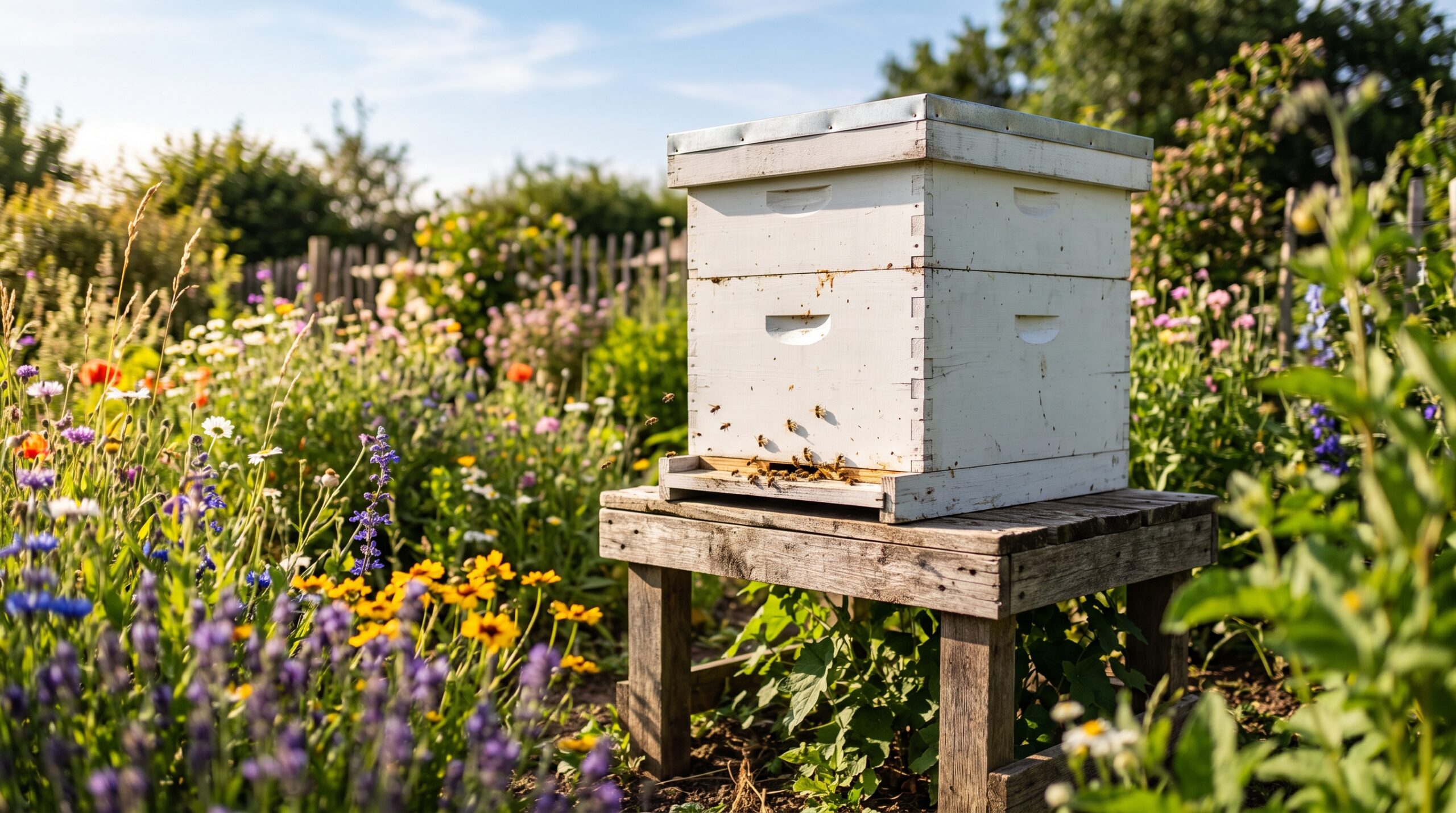
Location is the one decision about your hive you can’t easily undo. You can swap out equipment, replace a queen, change feeding methods — but moving an established colony is a real project, and doing it wrong means losing foragers. Spend time on placement before you order your bees.
I’ve moved hives in my apiary more than once over the years, always wishing I’d thought it through better the first time. Here’s what I look for now when I’m siting a new hive.
Sun: Morning Light Matters Most
Bees are early risers. Morning sun on the hive entrance gets workers flying earlier and foraging longer. A hive that sits in full shade until noon loses hours of productive foraging time every single day.
The ideal orientation is entrance facing southeast or south — morning sun, afternoon shade. In hot climates, afternoon shade is especially important. Hives in full August sun in Texas or Arizona can overheat; bees spend enormous energy on ventilation and clustering rather than storing honey. Dappled afternoon shade from a deciduous tree is close to perfect.
In cold northern climates, more sun exposure can help overwinter. Some beekeepers in Minnesota and Maine orient hives due south with a windbreak behind them to maximize warmth.
One caveat: avoid placing the hive directly under a tree that drops a lot of sap or honeydew. It makes sticky messes on the landing board and can attract pests.
Wind: Break It From the North and West
Winter wind is a real threat to colonies. A hive exposed to northwest winds on a hilltop in February loses heat fast, and bees have to work harder to maintain cluster temperature. Put a windbreak — fence, hedge, outbuilding — between the hive and the prevailing winter wind direction.
In summer, gentle airflow is actually beneficial. It helps ventilation and discourages moisture buildup inside the hive. You don’t want a hive in a dead-air pocket with no breeze ever. Wind break in winter, airflow in summer — a hedge or solid fence on the north side accomplishes both.
Water: They’ll Find It Themselves (and You Won’t Like Where)
Bees need water. A colony at peak strength in summer needs roughly a quart a day. If you don’t provide a water source near your hive, they will find one — and they tend to prefer shallow, stagnant water that smells organic. Your neighbor’s birdbath. The puddle by the air conditioning condenser. The dog’s water dish.
Provide a water source within about fifty feet of the hive. A shallow basin or tub with some floating corks or twigs so bees can land and drink without drowning. Start the water source before you install bees — they’ll learn it as home and won’t need to go looking. I use a galvanized tub with a layer of pebbles across the bottom. Rinse and refill twice a week in summer.
Neighbors: Think Flight Paths Before You Commit
This is the piece most beginners skip, and it’s the one most likely to cause real problems. Bees take the path of least resistance from the hive entrance to foraging territory. If a fence, hedge, or wall immediately in front of the entrance forces them upward, they fly over the obstacle and away — and your neighbors never notice them. If the entrance faces an open yard, bees at knee height are crossing wherever people walk.
Whenever possible, position the hive entrance so it faces toward a barrier — a solid fence, a dense shrub row, the side of a barn. The bees will fly up and over and be twelve feet in the air before crossing into a neighbor’s yard. This single adjustment eliminates the majority of neighbor complaints.
Check local ordinances before placement too. Many municipalities have setback requirements — ten, twenty, or fifty feet from property lines. Some require privacy screens of a certain height. Getting this wrong can mean having to move the hive after you’ve already installed bees, which is significantly more complicated than getting it right before installation.
Accessibility: You’ll Regret That Awkward Spot
You’ll inspect this hive at least twice a month during the active season. Make sure you can stand on both sides of it comfortably, pull frames without obstacles behind you, and set equipment down nearby. Hives tucked into corners, up against fences, or on steep slopes are miserable to work.
Also think about your route carrying supplies. A fifty-pound bag of sugar or a new super full of honey is heavy. If getting to the hive requires squeezing through a gate, navigating steps, or crossing a muddy path, you’ll skip inspections when you’re tired. Easy access means more consistent management.
Quick Reference: Site Checklist
- Morning sun on entrance (south or southeast facing)? ✓
- Afternoon shade in summer? ✓
- Windbreak on north/northwest side? ✓
- Water source within 50 feet, already established? ✓
- Entrance directed toward a barrier for flight-path control? ✓
- Setback from property lines per local ordinance? ✓
- Room to stand on all sides and work comfortably? ✓
Walk your yard with this list before committing to a spot. A half hour of reconnaissance now saves a season of headaches later. When you find a site that checks every box, set your stand, level it carefully, and you won’t have to second-guess it again.
Revisiting Placement as Your Apiary Grows
The spot that works for one hive doesn’t always work for four. As you add colonies, watch for competition between hives at the water source, drift of bees into neighboring hives with similar-looking entrances (staggering hive orientations slightly reduces this), and shade patterns that change seasonally. What looks like full morning sun in March may be partly blocked by a tree in full leaf by June. Walk your apiary site in each season before permanently committing to a layout for multiple hives.