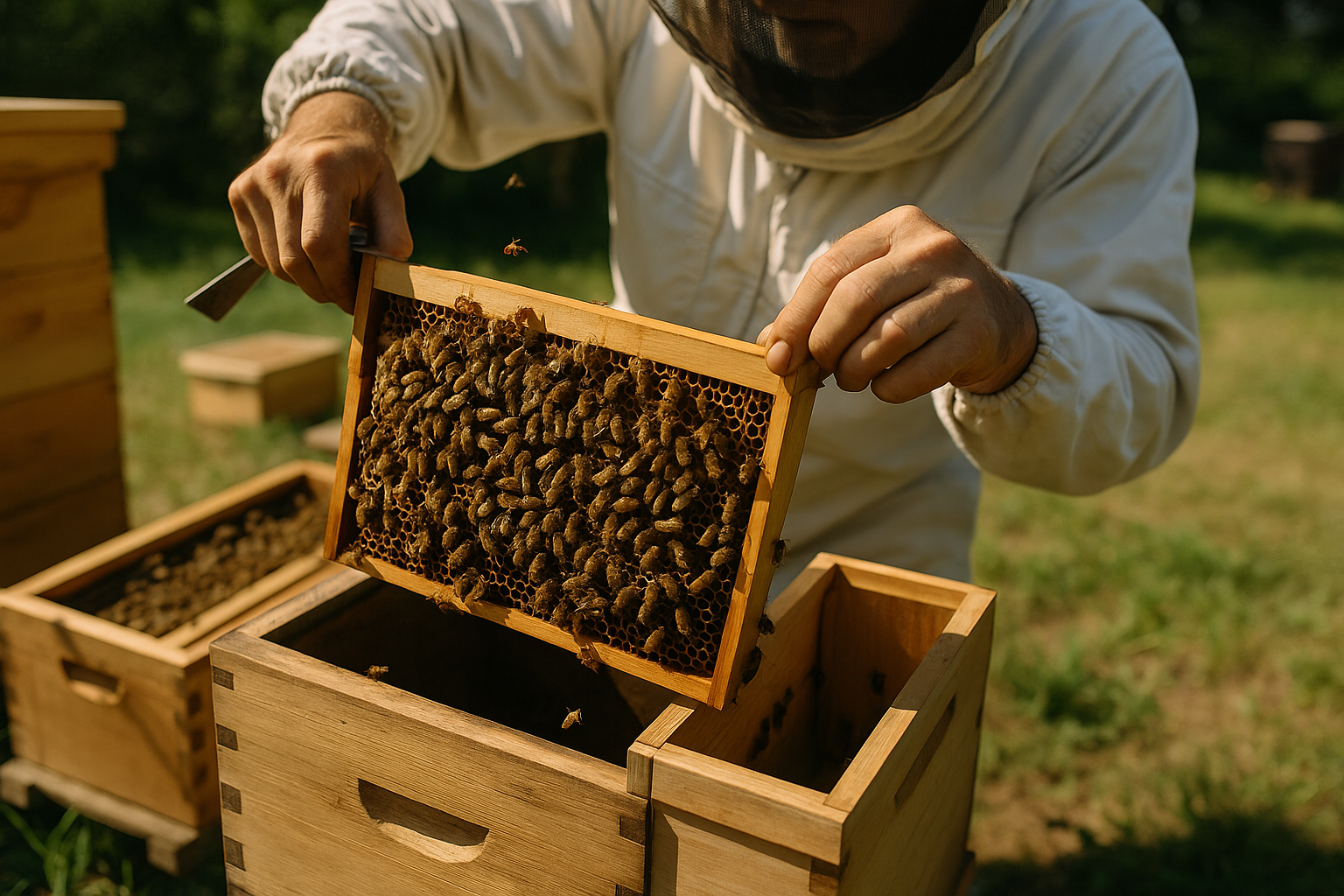
Splitting a hive is one of the most satisfying things you can do as a beekeeper. You start with one colony and end with two. You prevent swarming. You get a second chance to correct management mistakes from the year before. In my apiary, I split every strong colony that’s building up fast in spring, and I’ve found it’s one of the most reliable swarm prevention tools I have — when done at the right time.
The key word is right time. Split too early and you’ll end up with two weak colonies instead of one strong one. Split too late and the bees have already made swarm preparations, which means a queen cell is imminent whether you intervene or not. The window I aim for is when the colony occupies at least eight frames of bees, has a solid brood nest, and you’re about four to six weeks before your main nectar flow.
What You’ll Need Before You Start
- A nucleus box (5-frame nuc) or a full-sized hive body with all equipment
- At least one frame of open brood with eggs (for queen rearing) or a purchased mated queen
- Enough drawn comb or foundation to fill the new box
- A hive tool and smoker
- A new hive stand, preferably at least several yards from the original location
- A marker or tape to label the new split
Whether you use a nuc or a full-sized box depends on your goals. A 5-frame nuc is perfect for a small split that you’ll grow out over the summer. A full split in a 10-frame box is better if you need a production colony quickly.
Step 1: Find the Queen
Before you do anything else, find the queen and set the frame she’s on aside in a safe place — either back in the original hive body with the entrance closed, or in a separate box. This is important: whichever split gets the existing queen will recover faster. The queenless split will need to raise a new queen from eggs you provide, which takes about 23–24 days from egg to mated laying queen.
If you absolutely cannot find the queen — and some queens are genuinely hard to spot — you can do a “walk-away split” and let the bees sort it out. Move frames with eggs and young larvae into the new box. Whichever split ends up queenless will build emergency queen cells. It works, but you lose control over which colony gets the better genetics.
Step 2: Build the New Split
Transfer into the new box:
- Two to three frames of capped and open brood (with bees on them)
- One to two frames of honey and pollen for food
- Enough adult bees to cover all the frames — bees need to maintain brood temperature
- At least one frame with eggs, if the queenless split will raise its own queen
Close the new hive and move it to its permanent location. If you’re moving it within the same yard, move it at least three feet away and ideally reorient the entrance so flying bees returning to the old location drift appropriately. If you can move the split to a separate location six or more miles away for two weeks, you’ll avoid losing forager bees back to the parent colony.
Step 3: Managing the Queen-Right Split
The split that retains the original queen (call it Split A) is your queen-right colony. It will likely be lower on bees immediately after the split because you moved frames out of it. Check it after a week to make sure the queen is laying normally. Offer 1:1 syrup if stores are light. With good management, a queen-right split on four or five frames can rebuild to full strength within a month.
Step 4: Managing the Queenless Split
The queenless split (Split B) is where queen-rearing happens. Within 24 hours of becoming queenless, the bees will begin drawing out emergency queen cells on the youngest larvae available. Check after five days (not sooner — you’ll destroy cells in progress). You should see capped queen cells, typically multiple ones.
You have options at this point:
- Let the bees select their own queen naturally (first queen to emerge often kills the others)
- Remove all but one well-positioned, large queen cell to reduce fighting
- Pull some cells to start additional splits (an advanced technique once you’re comfortable)
The new queen will emerge 8 days after the cell is capped (day 16 from egg), take mating flights over the following week, and begin laying 5–7 days after that. Total time from split to first eggs: 23–28 days. Mark your calendar.
Common Mistakes When Splitting
- Not leaving enough bees: A split with only two frames of bees won’t have the workforce to keep brood warm in cool nights. Aim for at least three to four frames covered with bees.
- No eggs in the queenless split: If you don’t leave eggs or young larvae (under 3 days old), the bees cannot make a queen. They’ll raise an emergency queen from larvae that are too old, which often produces a poorly-mated or laying worker situation.
- Checking too early: Disturbing queen cells before they’re capped can lead to abandonment. Wait at least five days before your first inspection of the queenless split.
- Splitting during a dearth: Without incoming nectar, a queenless split has less incentive to raise a new queen and may fail. Time splits to coincide with early nectar flows.
Your first split will feel nerve-wracking. The second one feels routine. By your third, you’ll be pulling splits off strong colonies every spring without a second thought. Start with a strong colony, work carefully, and give the bees time to do what they do naturally. They’ll figure out most of it on their own.