My first farmers market was a disaster in slow motion. I showed up with thirty pounds of honey in unlabeled mason jars, a folding table I borrowed from the garage, and exactly no idea what I was doing. By noon, three people had stopped by. One asked if I took cards (I didn’t). One wanted to know if the honey was local (it was, but I stumbled explaining how local). One bought a small jar because she felt sorry for me. I drove home with twenty-eight pounds of honey and a deep need to rethink my approach.
Five seasons later, I run one of the more consistent honey booths at two different markets. I’m not the biggest or the flashiest — there’s a guy three stalls down with a foam beehive display and an iPad slideshow — but I sell out most weeks and have a core of repeat customers who text me before market day to hold jars. Here’s what changed.
Labels and Packaging Matter More Than You Think
People eat with their eyes before they eat with their mouth. A hand-applied label on a recycled jar signals “small hobby operation.” A clean, consistent label with your farm name, varietal, net weight, and location signals “this person takes their product seriously.”
You don’t need an expensive designer. Canva has honey label templates that look professional when printed on label paper. Make sure your label includes the net weight in both ounces and grams (required by the FDA if you’re selling across state lines or at markets with federal oversight), your state, and a lot/harvest date if you track those. Some buyers — especially at upscale markets — specifically look for harvest dates.
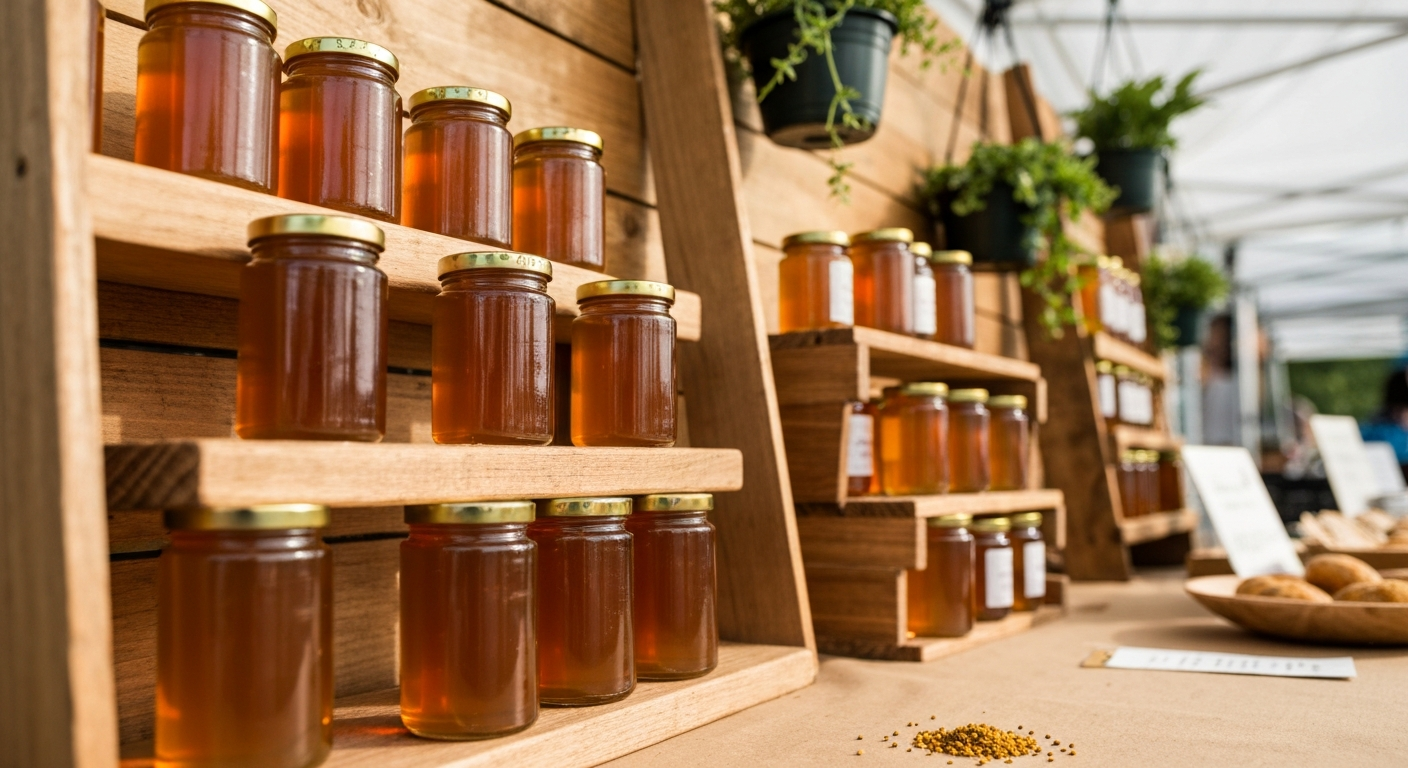
For jars, hex jars and bail-top jars photograph well and feel premium in the hand. Straight-sided Ball jars are fine but they read as “pantry item,” not “artisan honey.” The jar is part of your brand.
Sampling Is Your Most Powerful Tool
Every jar I’ve sold at market started with a sample. I keep two or three open honey jars on small wooden boards with honey dippers, and I offer tastes to anyone who slows down. The conversation that follows almost always results in a sale.
The sample isn’t just about flavor — it’s about engagement. When someone tastes your honey and you can talk about where your bees forage, what the bloom season was like this year, or what makes your sourwood different from your wildflower, you’ve transformed a transaction into a relationship. People buy from people they like.
Rotate your samples. If you have three varietals, put out different ones each week. Customers who’ve visited before get curious about what’s different. “Oh, is that the late-season goldenrod? I haven’t tried that yet” is a sentence I hear regularly, and it almost always ends with a jar in their bag.
Know Your Market’s Demographics Before You Book
Not all farmers markets are equal. A Tuesday lunchtime market in a downtown business district attracts office workers who want quick purchases. A Saturday morning market in a residential neighborhood draws families who browse longer and buy in volume. A high-end Saturday market near a foodie enclave attracts buyers who will pay premium prices and ask detailed questions about your bees.
Before committing to booth fees for a full season, attend the market as a shopper. How many honey vendors are already there? What are they charging? What’s the foot traffic like? A crowded Saturday market with two other honey sellers and six hundred visitors is probably better than a Tuesday market with no competition and forty visitors.
Booth Setup Basics
- Height: Products at eye level sell better. Use tiered shelving or risers to get smaller jars up off the table surface.
- Signage: Your farm name should be readable from fifteen feet away. A chalkboard sign with today’s featured varietal draws curious shoppers.
- Card reader: Get one before your first market. Square and Stripe both work offline and sync when you reconnect. Losing a sale because you’re cash-only is painful and avoidable.
- Printed price list: Customers shouldn’t have to ask how much things cost. A small card with product names and prices reduces friction.
- Business cards or QR code: For customers who want to follow your harvest updates or order before market day.
Common Mistakes Sellers Make
- Sitting behind your table: Stand. Move to the front. Engage people as they pass. A vendor who makes eye contact and says “want to try a taste?” closes more sales than one who waits to be approached.
- Under-stocking on good days: Running out of product by 10am means leaving sales on the table. Check weather forecasts — sunny days at popular markets move product fast.
- Ignoring repeat customers: Remember names or faces when you can. “Nice to see you again — the wildflower is back in stock” is worth more than any marketing you could do.
- Competing on price: Don’t drop your price because someone at the next stall charges less. Your honey’s quality, your story, and your consistency are your differentiators.
Building a Customer Base Beyond Market Day
The best thing that happened for my market sales was starting a simple email list. I put a sign-up sheet on my table — “Join our harvest updates list” — and now I email a short note twice a season when I have something new or when I’ll be at an upcoming event. It’s not fancy. It’s a text email that goes out to about two hundred people. But it fills market spots on slow weeks and lets me sell out before I leave home on the good ones.
Market success is patient work. Your first season is mostly education. By your third, you’ll have the regulars, the rhythm, and the setup dialed in. Don’t quit after one bad Saturday — the honey business rewards consistency more than almost anything else.