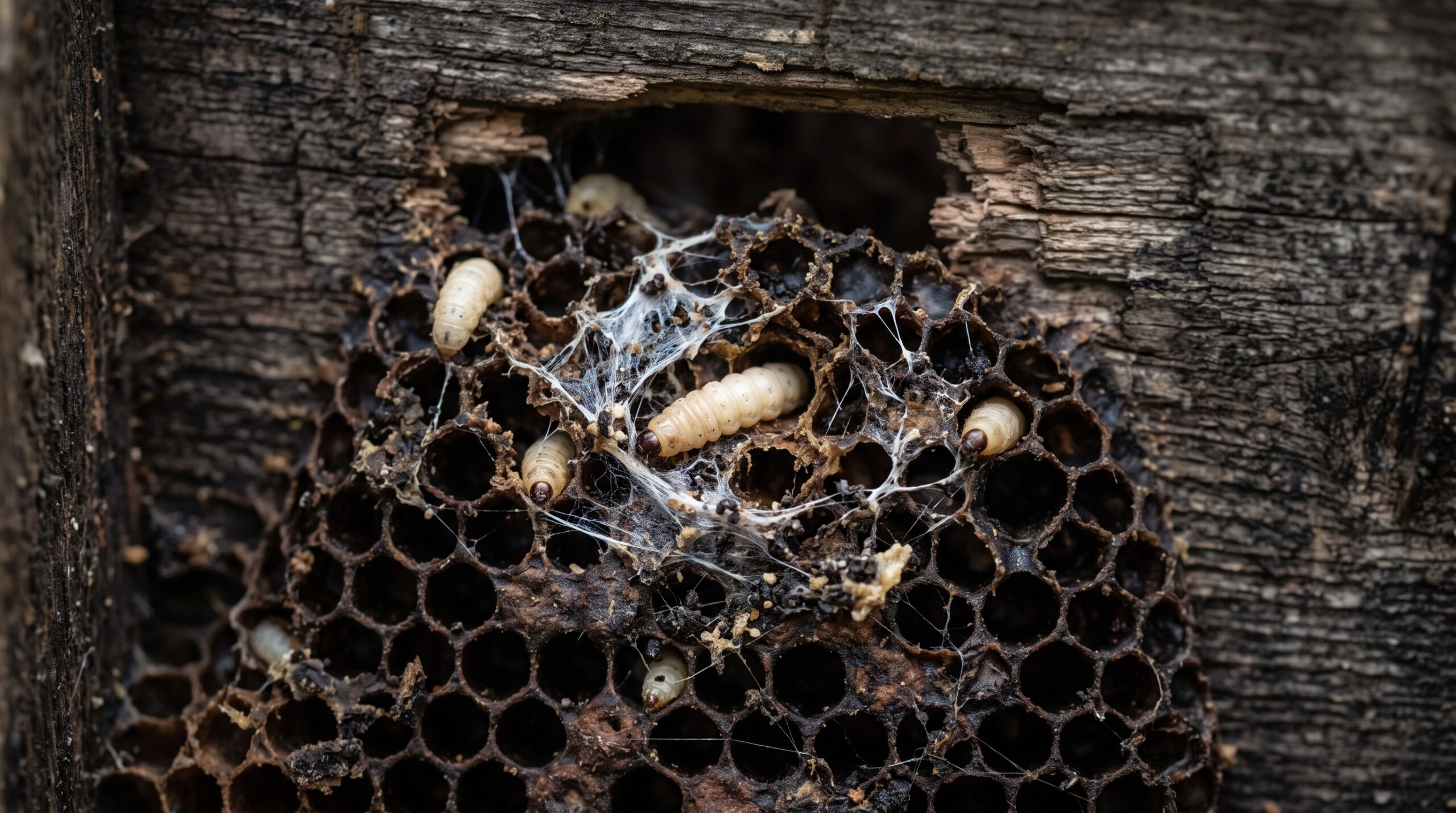
Wax moths get a bad reputation they don’t entirely deserve. Let me explain. Galleria mellonella (greater wax moth) and Achroia grisella (lesser wax moth) are opportunistic pests — they don’t cause problems in strong, healthy hives because the bees repel them. A colony with enough bees to cover the comb simply doesn’t let wax moths get established. What moths are very good at is destroying abandoned comb, stored equipment, and the combs of weak or collapsing colonies. That’s where they become a real headache.
In my apiary I’ve found wax moths in equipment within days of removing a collapsing hive. The females seek out dark, protected spaces — unused supers, hive bodies in a barn, stacks of drawn comb — and lay eggs in crevices. The larvae hatch quickly and tunnel through comb, spinning silken galleries as they go and leaving a mess of debris, frass, and destroyed wax. A super of beautiful drawn comb can be reduced to useless tunneled wreckage in a matter of weeks in warm conditions.
Detection: What to Look For
Inside active hives:
- White silk threads across comb: The earliest sign. Larvae spin protective galleries from silk. Fine white threads stretched across cell openings or along the bottom of frames indicate early infestation.
- Tunneling damage in comb and wood: Larvae bore through wax and into wooden frame rails, creating tunnels that are hard to clean. You’ll see chewed channels in wood and destroyed cells.
- Gray or brown frass: Wax moth frass (excrement) looks like fine gray or brownish granules, often mixed with silk debris. It accumulates on the bottom board.
- “Bald brood”: Wax moth larvae tunneling under capped brood cells expose the pupae, creating bare patches across otherwise capped brood. The bee pupae are visible through the damaged wax. This is distinctive and alarming-looking.
- Moths visible at night: Adult moths fly at night and are attracted to hive entrances. If you’re out at dusk and see moths hovering near hives, wax moths are present in the area.
In stored equipment:
- Silk webbing packed densely through supers or hive bodies stored in a barn or shed.
- Larvae visible in tunnels when you pull frames apart.
- Completely destroyed comb that’s been reduced to a mix of silk, frass, and cocoons.
Treatment for Active Infestations in Weak Hives
If a weakened colony has wax moth infestation, the colony is the primary problem — moths are secondary. Assess the colony first:
- Is the queen present and laying? Is the colony queenless or does it have a laying worker situation? Fix the colony issue first.
- Remove all frames with heavy silk or tunnel damage. Freeze frames at 0°F for 24–48 hours to kill all life stages (eggs, larvae, pupae, adults). Frozen frames can be cleaned and reused once you scrape out debris.
- Reduce the hive to a size the remaining bees can defend. Consolidate to one box if necessary.
- Clean silk, cocoons, and frass from surviving frames. Scrape cocoons from wood — they stick hard and the bees won’t readily remove them.
Protecting Stored Comb: What Actually Works
This is where most beekeepers want practical answers, and there are a few reliable methods:
Freezing: The most reliable and chemical-free option. Place frames in sealed bags and freeze at 0°F (–18°C) for a minimum of 24 hours. This kills all wax moth life stages. After freezing, return frames to sealed bags or containers. The only limitation is freezer space.
Para-Dichlorbenzene (PDB, “moth crystals”): These fumigant crystals are registered for use in stored bee equipment. Stack hive bodies with newspaper between boxes, place 2–3 tablespoons of PDB crystals on the top box, and seal. PDB vapors, being heavier than air, work downward through the stack. Let equipment air out thoroughly in the sun for several days before returning to bees — PDB residue repels bees if equipment smells of it.
Certan (Bacillus thuringiensis israelensis, Bt-based spray): A biological control registered for wax moth management in stored equipment. Spray on both sides of frames and allow to dry. The Bt toxin kills wax moth larvae that ingest treated wax. Effective, safe, and doesn’t require freezer space. Results aren’t quite as reliable as freezing, but for large quantities of stored comb it’s practical.
Air and light: Wax moths prefer dark, protected spaces. Storing supers with the frames turned vertically (standing on end) in an airy location with good light makes the environment less hospitable. Not enough to rely on alone, but combined with other methods it helps.
CO₂ treatment: Expose frames to high-concentration CO₂ in a sealed container or bag. Several commercial beekeeping suppliers sell CO₂ setups for this purpose. Effective but requires equipment purchase.
Common Mistakes
- Storing drawn comb in a sealed building without treatment. A warm, dark, enclosed space is ideal for wax moths. Even one adult moth can establish an infestation that ruins an entire super in 3–4 weeks.
- Blaming moths for a colony collapse that was really varroa or queen failure. Moths don’t cause healthy colonies to fail — they move into the vacuum left by a failing colony. Address the underlying cause.
- Forgetting to air out PDB-treated equipment. Bees won’t enter equipment that smells like PDB crystals. A week in the sun is usually enough; test with a small piece of comb placed near the hive entrance — if bees work it readily, the equipment is ready.
- Reusing heavily tunnel-damaged frames without inspection. Silk that’s packed into cell corners and wood grain is nearly impossible to remove completely and harbors cocoons. If a frame is more than 30–40% tunneled, it may not be worth keeping.
Prevention is simpler than rescue. Keep colonies strong, treat stored equipment immediately after harvest, and don’t leave drawn comb in an empty box in a warm place. Do those three things and you’ll rarely have a serious wax moth problem.