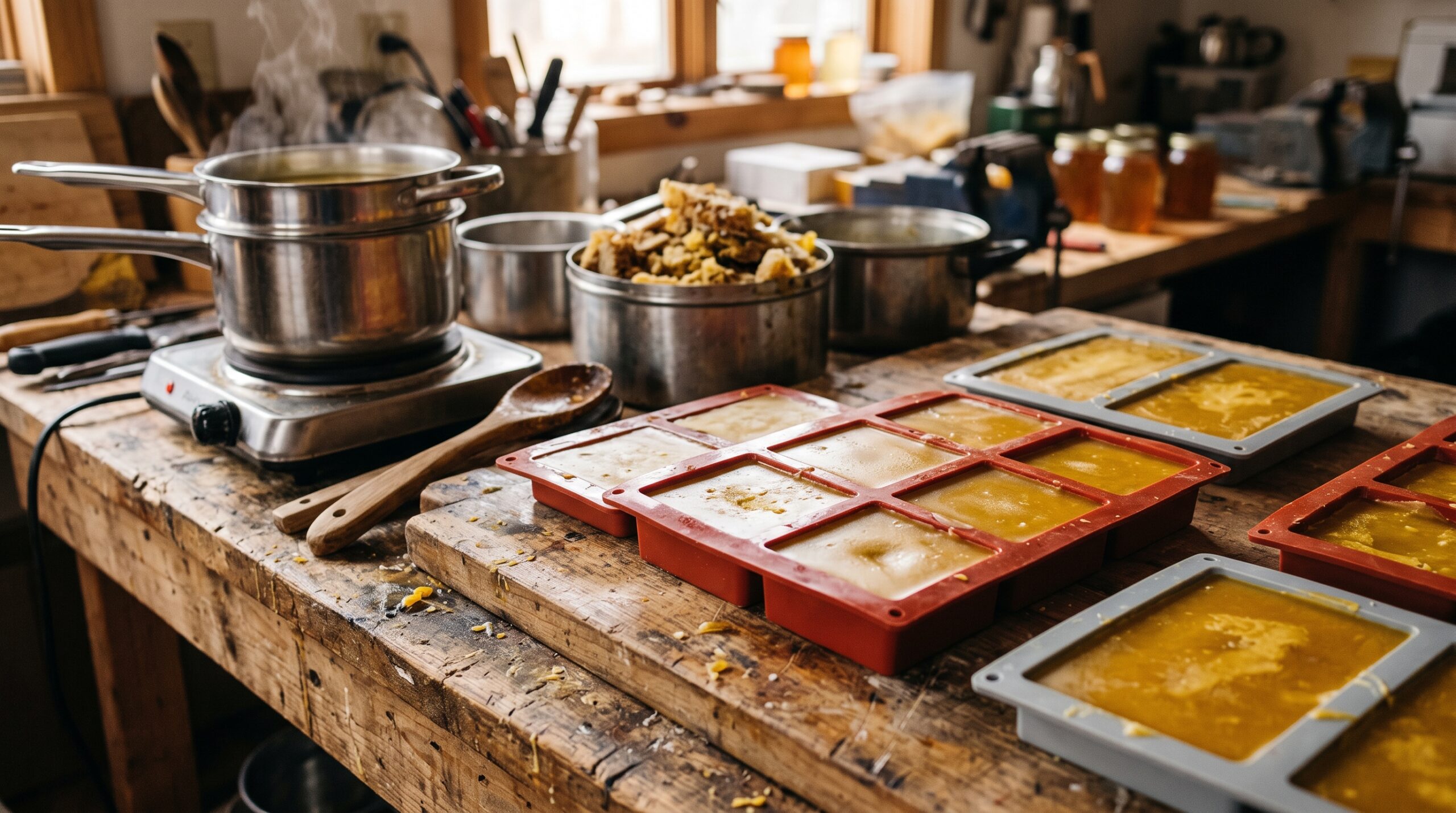
Most new beekeepers think of honey as the product and wax as the byproduct. After a few seasons, you start realizing that wax is worth paying attention to on its own terms. It’s a genuinely useful material — for candles, lip balm, wood polish, waterproofing, leather care, and food wraps — and recovering it from your cappings and old comb isn’t complicated once you know the process. You’re already handling the raw material every time you extract. Might as well not throw it away.
This guide walks through the full process: collecting wax through the season, melting and clarifying it, filtering out impurities, and producing blocks you can actually use or sell.
Where Wax Comes From in Your Operation
You’ll accumulate beeswax from two main sources:
Cappings wax — the thin layer of wax you slice or scrape off frames before extraction. This is the highest-quality wax you’ll get. It’s fresh, lightly colored (often pale yellow or white), and minimally contaminated. In my apiary, I collect every scrap of cappings and process them at the end of extraction season.
Old comb wax — from frames you’re rotating out of your brood boxes. Brood comb darkens with age as propolis, cocoon silk from larval casings, pollen, and other materials accumulate. Dark wax can still be processed but requires more thorough filtering and produces a darker, brown-tinged end product. The wax itself is structurally sound; it’s just less visually appealing. Old dark comb produces wax suitable for wood finishing or waterproofing but not for cosmetics or candles where color matters.
What you won’t want to process: Frames damaged by wax moth, frames from hives that had American Foulbrood, or comb with visible mold beyond surface spots. Wax from AFB-infected hives should be incinerated per your state regulations — the Bacillus larvae spores can survive rendering and contaminate future equipment.
Collecting and Storing Raw Wax
During extraction, collect cappings in a food-grade container. A double-layer setup works well: a coarse strainer over a bucket catches the cappings while letting most of the residual honey drain through overnight. After 12–24 hours, the cappings will have drained significantly. You’ll still have honey-wet wax, which is fine — it’ll all separate during melting.
Store raw wax in sealed buckets until you’re ready to process. It won’t go bad. Dry it out somewhat before storing if you can — wet wax sitting for months can develop mold on the surface, which affects clarity. I typically process cappings within a couple of weeks of extraction, but I’ve stored raw wax for six months with no significant issues.
The Melting Process
The melting point of beeswax is 62–65°C (144–149°F). Your goal is to melt the wax and allow impurities — pollen, propolis, cocoon material, and debris — to either float or sink, then pour off the clean wax.
Solar melter (my preferred method for cappings): A solar wax melter is a wooden or insulated box with a glass or polycarbonate lid, angled toward the sun. It works on the same principle as a greenhouse. On a hot sunny day, interior temperatures can reach 65–80°C, easily melting wax. The wax drips through a mesh screen into a mold at the bottom; impurities stay above the screen. No fuel or electricity needed. Slow for large quantities but perfect for season-long accumulated cappings.
Double boiler method: For bulk processing, melt wax in a pot nested over a larger pot of boiling water (never put wax directly on a flame — it’s flammable above ~300°C/570°F, but water in the outer pot provides a temperature ceiling). Add a small amount of water to the wax pot; this helps impurities settle and creates a separation layer. Stir occasionally. Once fully melted, pour through a mesh strainer or cheesecloth into molds. Let it cool slowly.
Important:** Don’t walk away from melting wax on a stove. It’s not going to spontaneously ignite at the temperatures you’re working with, but it’s still a fat and should be treated accordingly. Have a lid nearby.
Filtering and Clarifying
Fresh-melted wax often looks turbid and brownish. After it cools in a mold, the bottom of the block will have a layer of “slumgum” — the dark, waxy residue containing all the filtered-out material. Scrape this off the bottom of the block and discard or compost it.
For cleaner wax, re-melt the block a second time and filter through cheesecloth. A third melt and filter produces the clearest result. Each re-melt and filter step removes more residual particulate. For cosmetic-grade wax (lip balm, skin care), I do three passes minimum. For candles, two is usually sufficient. For wood finish or technical use, one is fine.
Molds and Finished Blocks
You can pour wax into almost any heat-resistant mold: silicone molds, flexible rubber molds, or simply a lined cardboard box. I use silicone loaf pans — the wax pops out easily after cooling and produces consistent half-pound blocks. Let wax cool slowly (covering the mold or insulating slightly) to prevent surface cracking.
Finished blocks keep indefinitely. Store them in a cool, dark place. They’ll pick up aromas from strong-smelling neighbors (don’t store near onions), but otherwise they’re completely stable.
Quick Reference: Wax Processing Checklist
- Collect: cappings and old brood frames (never AFB frames)
- Drain honey from cappings before melting
- Melt using solar melter or double boiler (never direct flame)
- Pour through cheesecloth into molds
- Scrape slumgum off cooled blocks
- Re-melt and filter 2–3× for cosmetic-grade wax
- Store finished blocks in a cool, dark location
Once you’ve got the rhythm down, wax processing adds maybe two or three hours of work per season for a small operation, and the output — whether you use it yourself or sell it — is genuinely worth that time. Your first batch of candles made from your own hive’s wax tends to change how you think about your bees. There’s something satisfying about using nearly everything they produce.