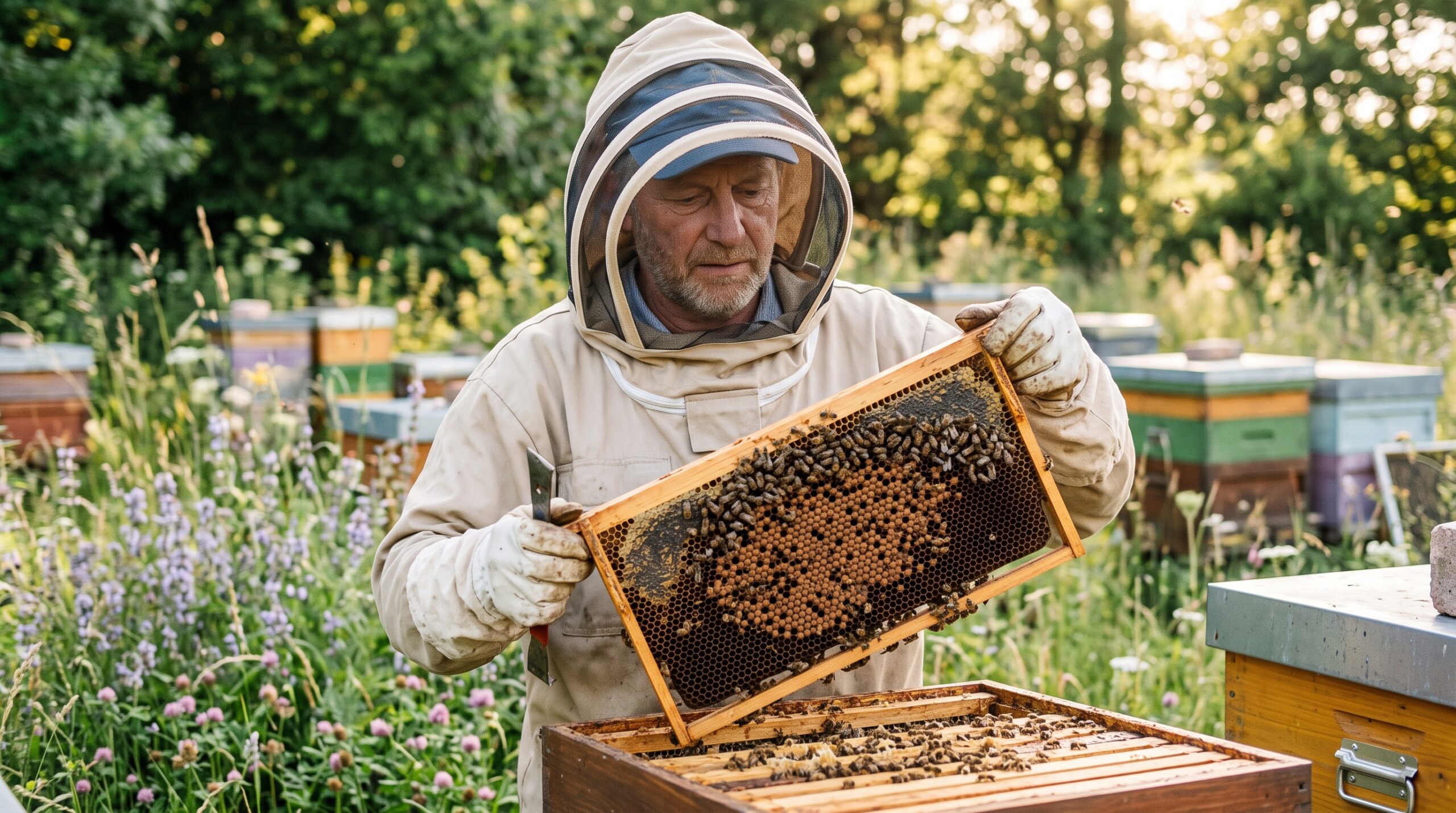
American Foulbrood is the disease every beekeeper hopes they never see — and the one you absolutely cannot afford to miss. Unlike most hive problems that can be treated and managed, AFB caused by Paenibacillus larvae is a notifiable disease in most US states, and in many cases the only legal response is to burn the infected equipment. The spores are extraordinarily resilient, surviving in old comb and woodware for decades. One infected colony left unmanaged can spread AFB to healthy hives across an entire apiary through drifting bees, robbing, and shared equipment.
I’ve inspected hundreds of hives over the years and encountered AFB twice — once in a hive I purchased as a nuc (the previous beekeeper almost certainly knew something was wrong), and once in a hive that had robbed out a collapsing neighbor. Both times, identifying it early made a significant difference in how much damage was contained. Here’s what you need to know to recognize it before it spreads.
What AFB Looks Like: The Core Signs
AFB attacks the brood, specifically the larvae after they’ve been capped. Healthy capped brood should have a uniform, slightly convex, tan or light brown surface. AFB disrupts this in several distinctive ways:
- Sunken, discolored cappings: Infected cells look dark brown, sunken inward, and may appear greasy or moist. The normal convex shape is gone.
- Perforated cappings: Bees detect the problem and may chew holes in infected cells, leaving irregular perforations in what would otherwise be capped brood.
- Ropiness: This is the definitive field test. Insert a matchstick or twig into a suspect cell and slowly withdraw it. AFB-infected larvae form a sticky, ropy brown strand that stretches 1–3 centimeters before breaking. A healthy dead larva will not do this. If you get the rope, you have AFB.
- Foul odor: AFB produces a characteristic smell — rotting, slightly glue-like. Experienced beekeepers recognize it immediately. If your hive smells strongly wrong during inspection, investigate the brood carefully.
- Scattered brood pattern: Infected cells interspersed with healthy capped brood creates the “pepper pot” or shotgun pattern often associated with brood diseases.
- Dark brown, dried scales: In advanced cases, the dead larvae dry to flat, dark scales adhered to the cell walls. Unlike European Foulbrood scales, AFB scales cannot be removed easily — they stick tight to the bottom of the cell.
How to Do the Ropiness Test Correctly
The matchstick test is your most reliable field diagnostic. Here’s how to do it properly:
- Identify a few suspect cells — sunken, discolored cappings, or perforations.
- Use a toothpick, matchstick, or thin twig. Do not use your hive tool (contamination risk).
- Insert gently into the cell until you feel resistance, then slowly pull straight out.
- Watch for the thread. A true AFB rope will stretch 1–3 cm and be brown and stringy. European Foulbrood and sacbrood may produce a small amount of material but nothing like the sustained rope of AFB.
- Dispose of the toothpick into a sealed bag — AFB spores can be transferred on tools.
If you get a rope, stop your inspection immediately. Do not shake bees between frames. Minimize disruption to avoid spreading infected material. Wash your hands and hive tool with soap and water before touching any other hive.
Distinguishing AFB from Other Brood Diseases
Not every discolored larva is AFB. Knowing the differences prevents misdiagnosis:
- European Foulbrood (EFB): Affects larvae before capping, so you’ll see twisted, discolored uncapped larvae — yellow, brown, sometimes melted-looking. EFB does not produce the ropiness characteristic of AFB. Colonies often recover from EFB with requeening and good management.
- Sacbrood: Dead larvae take on a sac-like appearance filled with watery fluid — they look like a sealed bag. The color progresses from white to yellow to dark. No ropy thread. Often self-limiting.
- Chalkbrood: White or grey chalky mummies, usually found on the bottom board or at the hive entrance. Hard, not ropy. Fungal, not bacterial.
What To Do If You Suspect AFB
This is where the disease’s severity really hits home for new beekeepers. AFB is a legal matter in most states, not just a management decision.
- Confirm your diagnosis. The ropiness test, combined with the visual signs and smell, is usually definitive in the field. If you’re uncertain, collect a sample — 5-10 affected larvae in a sealed container or a small piece of comb in a plastic bag — and submit it to your state apiarist’s lab for confirmation.
- Report to your state apiarist. AFB is a reportable disease in most US states. Contact information is usually available through your state’s department of agriculture. They can help confirm diagnosis and advise on legal obligations.
- Do not attempt to sell, give away, or move infected equipment. This is how AFB spreads across apiaries. Quarantine the hive completely.
- Understand your options. In most cases, the infected colony must be destroyed — ether killed with soapy water or gasoline-based fume, then the hive contents burned. Woodware can sometimes be scorched internally with a torch and reused, but equipment treatment is jurisdiction-specific. Ask your apiarist.
Prevention: What Actually Helps
- Never use old comb of unknown origin. AFB spores in old comb are invisible and can survive 40+ years. If you don’t know the comb’s history, don’t use it.
- Avoid feeding honey of unknown origin. AFB can be spread through infected honey. Never feed honey from a source you don’t trust.
- Don’t share equipment between apiaries without decontamination. Hive tools, brushes, and protective clothing can carry spores.
- Keep colonies strong. Strong colonies are better at detecting and removing infected larvae before the disease establishes. This isn’t foolproof, but it helps.
- Inspect brood regularly. Catching AFB at 1–2 affected cells is infinitely better than catching it when half the colony’s brood is diseased.
American Foulbrood is frightening precisely because it demands swift, decisive action. But it’s also very recognizable once you know what to look for. Add the ropiness test to your inspection routine — take 30 seconds per hive to check a few brood cells with a toothpick — and you’ll catch it early if it ever arrives. That early catch is the difference between losing one hive and losing your apiary.