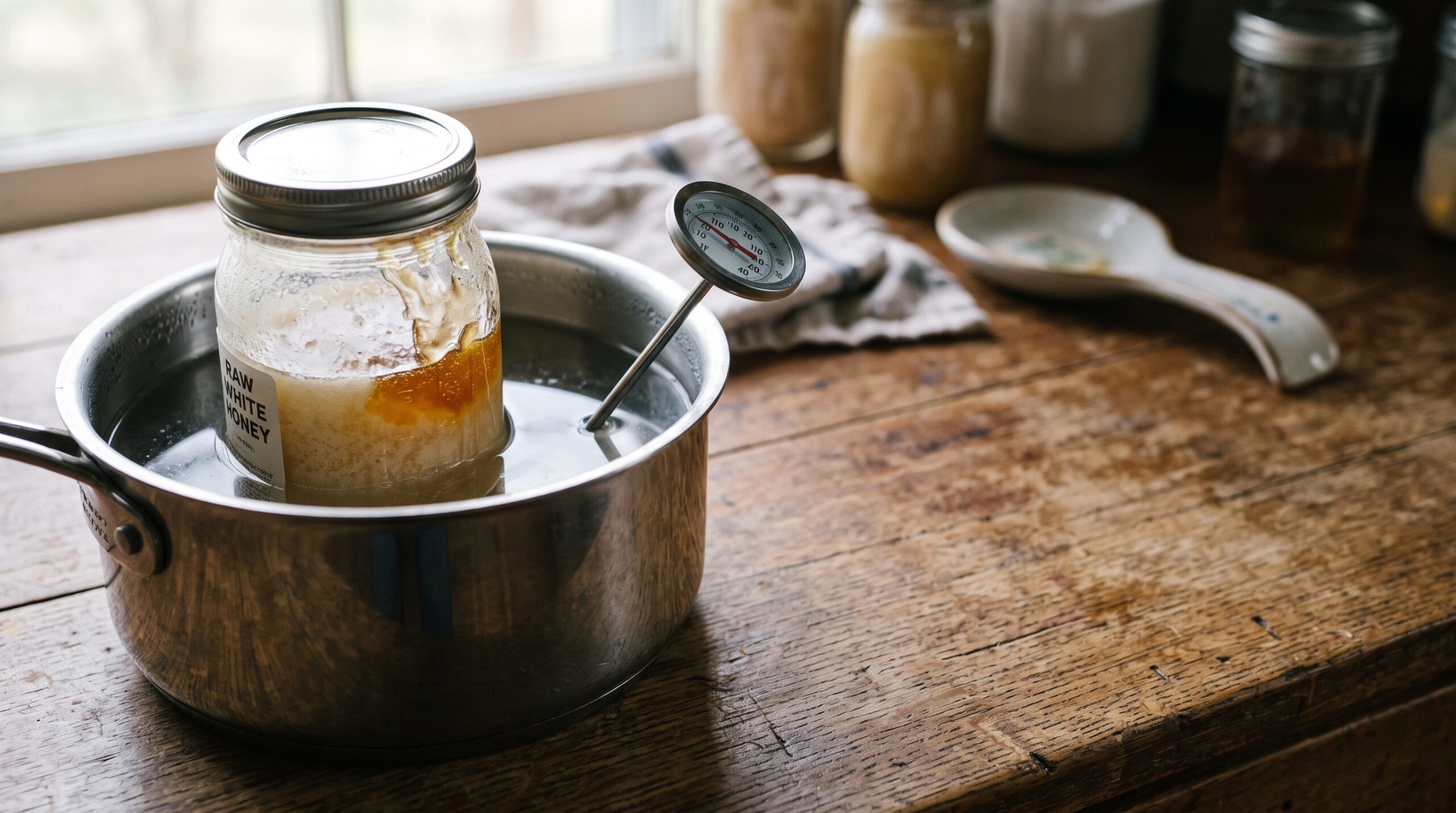
It happens to almost everyone who keeps honey on the shelf for more than a few months: you reach for the jar and find it’s thick, grainy, and won’t pour. The color has shifted — lighter, often white or pale yellow at the edges. Your first instinct might be that something went wrong. It didn’t. What you’re looking at is crystallized honey, and it’s one of the most misunderstood things about a product that millions of people eat without fully understanding.
Crystallized honey is not expired. It’s not spoiled. In fact, it often indicates that the honey is lower in water content and higher in glucose — both signs of good quality. Here’s what’s actually happening, why it varies between honeys, and the safest way to bring it back to a pourable state without damaging it.
Why Honey Crystallizes in the First Place
Honey is a supersaturated sugar solution. It contains far more dissolved sugar than water can normally hold — approximately 80% sugars by weight in a typical honey, with water making up only 17–18%. At room temperature, this oversaturation is unstable. Sugar molecules gradually come out of solution and form crystals, a process called nucleation and growth.
The primary sugar that crystallizes is glucose. Fructose remains liquid. This matters because different nectar sources produce honey with different glucose-to-fructose ratios, which is why some honeys crystallize dramatically faster than others:
- Rapid crystallizers (days to weeks): Canola (rapeseed), clover, alfalfa, dandelion. These are high in glucose relative to fructose.
- Moderate crystallizers (weeks to months): Wildflower, basswood, tulip poplar, most mixed-source honeys.
- Slow or resistant crystallizers (months to years): Tupelo, black locust, yellow box (Australian), sourwood. High fructose-to-glucose ratios.
Temperature accelerates nucleation at around 57°F (14°C). This is why honey stored in a cool pantry crystallizes faster than honey kept at room temperature. And why refrigerated honey crystallizes almost immediately.
Pollen particles also act as seed crystals, providing surfaces for glucose to attach to. Ultra-filtered commercial honey with all pollen removed crystallizes much more slowly — but at the cost of the pollen content that makes raw honey nutritionally interesting.
Is Crystallized Honey Safe to Eat?
Yes, unambiguously. Crystallized honey has the same nutritional profile, the same flavor compounds, and the same antimicrobial properties as liquid honey. Many beekeepers and honey enthusiasts actually prefer it — it spreads on bread like butter, doesn’t drip, and can be eaten by the spoonful with a satisfying texture. European markets often sell “creamed honey” (controlled fine-crystal honey) as a premium product.
The only time crystallized honey is a problem is if it’s crystallized AND showing signs of fermentation: bubbling, an alcohol-sour smell, or a distinctly off taste. That combination means water content was too high at the time of harvest and yeasts activated. Fermented honey is a different issue entirely (and a topic for another post). Crystallized-only honey without fermentation signs? Eat it as-is or re-liquefy it — your call.
How to Reverse Crystallization Safely
The goal is to gently warm the honey until the glucose crystals dissolve back into solution. The key word is gently. Above 45°C (113°F), you start degrading enzymes. Above 50°C (122°F), you’re measurably damaging the honey. Commercial processors use high heat to prevent re-crystallization, but for home use, you want to stay low and slow.
Method 1: Warm water bath (recommended)
- Place the honey jar in a pot or basin of warm water. Water temperature should be around 35–40°C (95–104°F) — hot to the touch but not scalding. You should be able to hold your hand in it.
- Stir the honey gently every 15–20 minutes. This distributes heat and breaks up the crystal structure.
- Replace the water as it cools. This takes 1–4 hours depending on how firmly crystallized the honey is and the jar size.
- Once fully liquid, remove and let cool to room temperature before sealing.
Method 2: Warming cabinet or dehydrator
Set a food dehydrator or warming cabinet to 38°C (100°F). Place jars inside for several hours or overnight. Stir occasionally. This is my preferred method for multiple jars — I can set it and let it run. The key is keeping the temperature below 45°C.
Method 3: Sunlight (use cautiously)
A jar in direct summer sun can warm honey effectively, but temperatures inside glass in direct sun can spike quickly to 60–70°C on a hot day. If you use this method, monitor with a thermometer and don’t leave it unattended.
What not to do:
- Don’t microwave honey. Microwaves heat unevenly and can create hot spots well above safe temperatures. The outside of the jar may seem cool while the center has reached 70°C+.
- Don’t boil water and put the jar in it. Boiling water is 100°C — far too hot.
- Don’t use a stovetop directly under the honey jar.
Will It Crystallize Again?
Almost certainly yes, and faster than the first time. Once nucleation has occurred and you dissolve it, microscopic crystal seeds may still remain that provide immediate starting points for re-crystallization. Some people solve this by fine-straining the re-liquefied honey before re-bottling to remove those seed crystals.
Alternatively, embrace it. Controlled crystallization — “creamed honey” — is intentional crystallization managed to produce a fine, spreadable texture rather than the coarse graininess of uncontrolled crystallization. Stir in a tablespoon of smooth, fine-grained honey as a starter and keep at around 57°F until the whole batch sets to a uniform, creamy consistency. It’s a beautiful product and doesn’t require re-liquefying at all.
Quick Reference: Crystallization Facts
- Crystallized honey is safe and fully edible as-is
- High glucose honeys (clover, canola) crystallize fastest
- Never heat above 45°C (113°F) to preserve enzymes
- Warm water bath at ~38°C is the safest reversal method
- Expect re-crystallization within weeks to months after re-liquefying
Next time you find a crystallized jar in the back of the cupboard, treat it as an opportunity rather than a problem. Warm it gently, give it a stir, and remember you’re looking at chemistry that’s been running exactly as intended. That’s not a flaw — that’s what real honey does.