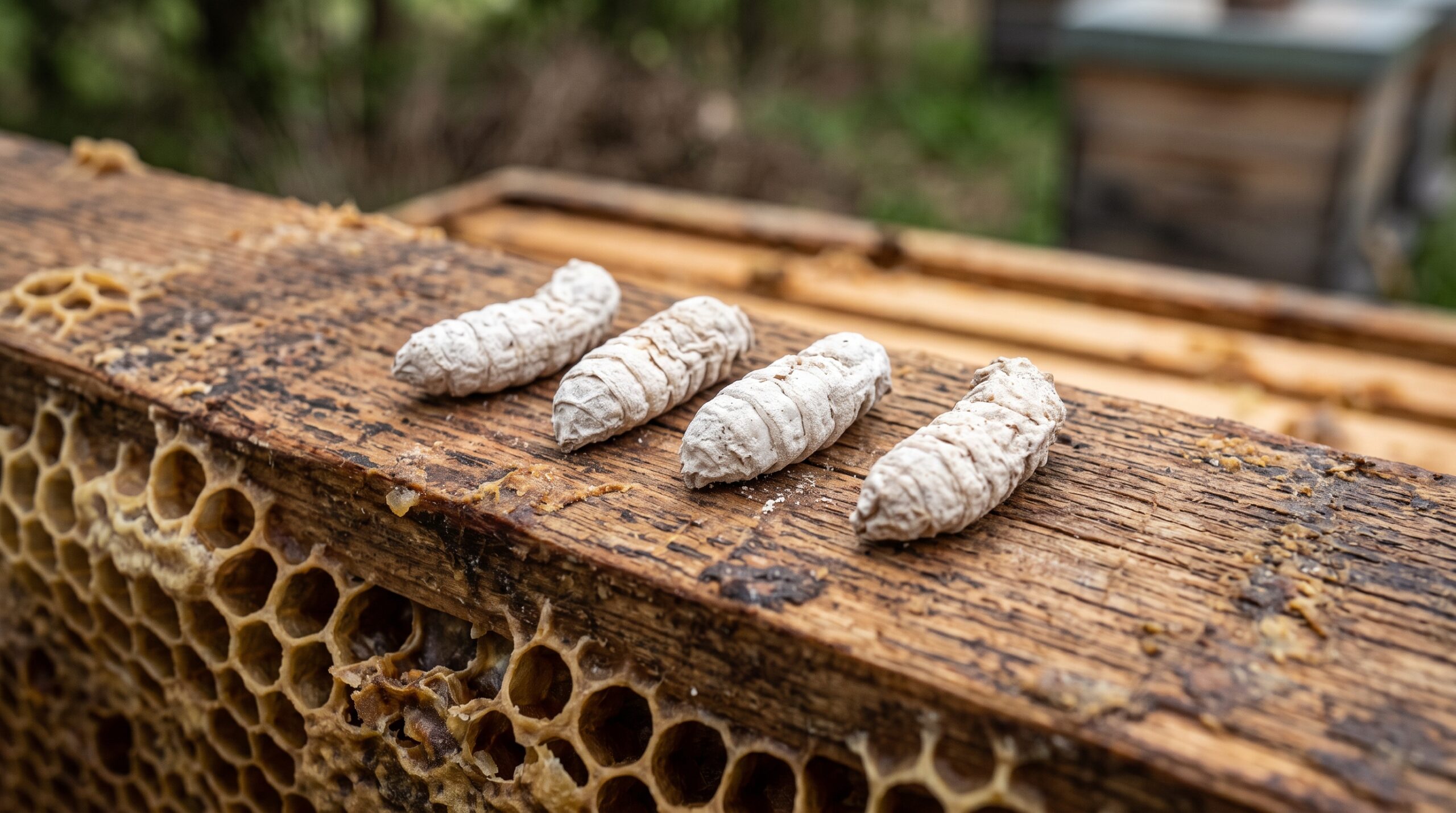
The first time I pulled a frame with chalkbrood, I thought something had gone seriously wrong. The brood pattern was fine one week, and the next I was finding small white and grey lumps scattered across the bottom board and piling up near the hive entrance. It took me a minute to recognize them as mummified larvae — the signature presentation of chalkbrood, caused by the fungus Ascosphaera apis. Once you’ve seen it, you won’t mistake it for anything else.
The good news: chalkbrood is almost always self-limiting. Most colonies clear it on their own when conditions improve. The bad news: it signals something about your hive’s environment or population strength that you should address, because a colony that can’t clear chalkbrood is a colony that probably has other underlying issues.
Identifying Chalkbrood
Ascosphaera apis is a fungal pathogen that infects bee larvae after they’ve been capped. The fungus grows through the larva’s body, eventually mummifying it. The mummies progress through predictable visual stages:
- Early stage: Larvae appear white and chalky — soft, spongy, and often still retaining the shape of the larva. The fungal mycelium is white at this point.
- Later stage: Mummies turn dark grey to black as the fungus sporulates. You’ll see grey or black mummies, sometimes called “salt and pepper” brood when white and grey mummies are mixed on the same frame.
- Removed mummies: Bees detect infected larvae and evict them. You’ll find hard, chalky mummies on the landing board, at the hive entrance, or scattered on the ground in front of the hive.
The brood pattern in chalkbrood-affected colonies typically looks scattered — some capped, some mummified — creating the irregular “pepperbox” appearance. You may also see perforated cappings where bees have partially chewed through to remove affected larvae.
Chalkbrood does not produce ropiness (that’s AFB), does not smell bad (healthy chalkbrood mummies are essentially dry), and does not kill adult bees. If your hive smells foul or larvae are melting, look for other causes.
Why Chalkbrood Happens
Understanding the conditions that favor chalkbrood helps you address the root cause, not just the symptom.
- Damp, poorly ventilated hives: A. apis thrives in cool, moist conditions. Hives with too little ventilation, sitting in low-lying areas with poor air circulation, or with condensation problems are much more susceptible. In my apiary, I noticed chalkbrood was far more common in hives positioned in a low corner of the yard that didn’t get morning sun.
- Chilled brood: A colony that doesn’t have enough adult bees to properly thermoregulate the brood nest will have temperature drops in peripheral areas of the brood. Cold brood is much more vulnerable to fungal infection. Chalkbrood appearing in the outer edges of the brood nest is a classic sign of this.
- Weak colony population: Small clusters, heavily varroa-infested colonies, or colonies recovering from an issue often develop chalkbrood because they lack the bee mass to maintain brood nest temperature and execute hygiene behaviors efficiently.
- Genetic susceptibility: Some queen lines are known to produce colonies with poorer hygienic behavior. If you have persistent chalkbrood across multiple seasons in one hive while others in the same apiary stay clear, the genetics may be part of the problem.
How I Handle Chalkbrood
My approach depends on severity and the time of year:
Light chalkbrood in spring: Watch and wait. As temperatures rise and the colony expands, most light chalkbrood clears on its own. I’ll increase ventilation by tilting the hive slightly forward or adding a screened bottom board if it’s not already present. I might reduce the entrance temporarily if I’ve been using a large entrance in cold weather, then open it back up as things warm.
Persistent or heavy chalkbrood: I’ll remove the worst affected frames of brood and replace with empty drawn comb. This removes the fungal spore reservoir and forces bees to recluster on a tighter brood nest where they can maintain temperature better. I don’t discard the equipment — I scrape the frames clean, let them dry thoroughly in full sun for a few days, and return them once cleared.
Chalkbrood recurring across seasons: At this point I consider requeening with a known-hygienic stock. Hygienic behavior — the tendency of worker bees to detect, uncap, and remove diseased brood — is one of the most important genetic traits for disease resistance. Colonies with strong hygienic behavior clear chalkbrood much faster. VSH (Varroa Sensitive Hygiene) queens are bred specifically for this trait and typically perform well on chalkbrood too.
What Not to Do
- Don’t use fungicides. There are no registered fungicide treatments for chalkbrood in honey bee colonies in the US. Don’t be tempted to experiment — the hive microbiome is complex and you risk more harm than good.
- Don’t add boxes to a struggling colony. Adding supers or additional hive bodies to a colony already too small to thermoregulate properly makes chalkbrood worse. Give bees space they can actually cover.
- Don’t ignore the varroa load. Chalkbrood and high mite levels often coexist — varroa weakens bees and reduces their capacity for hygienic behavior. Before attributing problems to chalkbrood, confirm your mite count is in range.
Quick Reference
- Cause: Fungus Ascosphaera apis
- Appearance: White or grey/black chalky mummies in cells or on bottom board
- Risk level: Usually low — self-limiting in healthy colonies
- Primary fix: Improve ventilation, reduce cold drafts, strengthen colony, requeen if persistent
- No registered drug treatment available
- Watch for: Reoccurrence in same hive across seasons (genetics issue)
Chalkbrood is often a canary in the coal mine — not the crisis itself, but a signal that something in your hive’s environment or population dynamics needs attention. When you find it, resist the urge to treat with something and instead ask why the bees aren’t handling it themselves. Answer that question, and the chalkbrood usually takes care of itself.