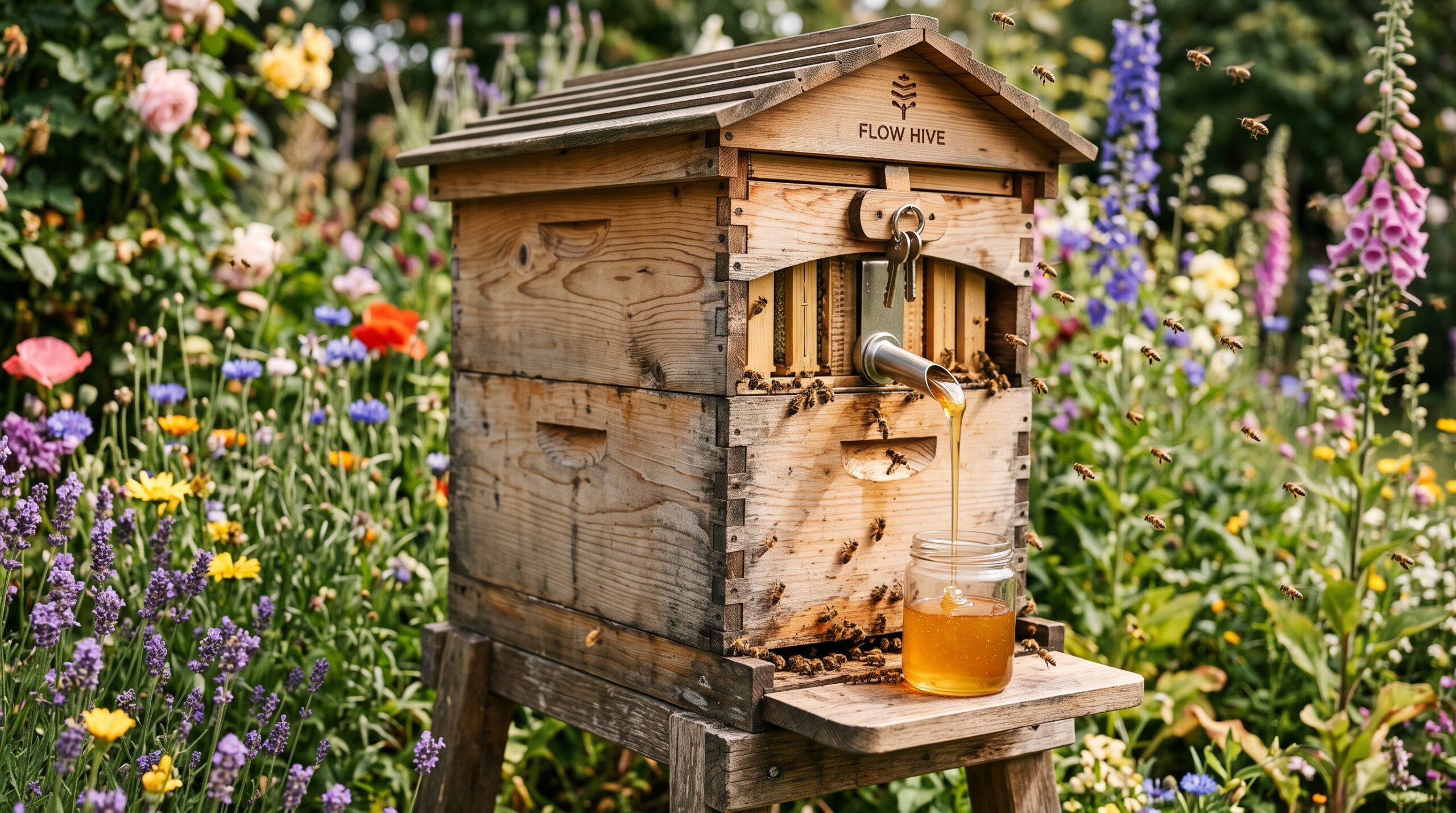
When the Flow Hive launched on Indiegogo in 2015, it raised over $12 million — the most successful crowdfunding campaign for a beekeeping product in history. The pitch was seductive: turn a tap, watch golden honey flow straight into a jar, no extraction equipment needed, no mess, minimal disturbance to the bees. For the record, I was skeptical from day one. After three full seasons using one in my apiary alongside conventional Langstroth setups, I have a more nuanced view. The Flow Hive is genuinely useful for some beekeepers. It’s genuinely oversold for others. Here’s the honest version.
What the Flow Hive Actually Is
The Flow Hive is a modified Langstroth hive system with a patented super containing frames made of split plastic cells. When you turn the harvest key, a rod rotates the cells so honey can flow down channels and out through a tube. The comb cells align again after harvest, and bees fill them for the next round.
It’s a clever mechanical solution to one genuine problem in beekeeping: extraction requires equipment, space, and time that many hobbyists don’t have or don’t want to invest in. If you have two or three hives and don’t want to buy an extractor, the Flow Hive solves that. That value is real.
The Flow Hive comes in two main configurations: the original cedar/timber version (the one marketed aggressively online) and the more affordable hybrid models. A complete Flow Hive 2+ runs $800–1,000+ for a full setup. You can buy a Flow super to retrofit to an existing Langstroth brood box for roughly $500–600.
What I Found After Three Seasons
Harvest convenience — accurate. Harvesting is genuinely easier and faster than conventional extraction. Turn the key, watch the honey flow, collect in a jar. No uncapping, no extractor spin-up, no cleanup. For honey from one super, it saves several hours of work. On a cool evening, I’ve done a complete harvest in twenty minutes while the bees barely noticed.
No-disturbance claim — partly accurate. The promotional materials imply you can harvest without opening the hive, and that’s technically true for the harvesting step itself. But you still need to open the hive regularly for inspections. You need to check for disease, assess the queen, monitor for swarming. Beekeeping responsibilities don’t disappear because the honey comes out differently. Beekeepers who bought Flow Hives believing they’d need to inspect less were sold a fantasy that doesn’t exist in functional apiary management.
Bees’ acceptance of plastic frames — variable. Conventional wisdom says bees prefer wax to plastic. In my experience, this holds partially. Two of my three Flow Hive setups had bees readily drawing and filling the Flow frames within a few weeks. One colony was reluctant for an entire season, filling fewer than half the cells and never producing a harvestable amount. I tried rubbing beeswax on the plastic cells (the standard recommendation) with marginal improvement. This isn’t a failure rate I’d accept in a conventional setup, and it underscores that individual colony behavior varies.
Honey quality — equivalent, with a catch. Honey from Flow frames tests the same as conventionally extracted honey for water content, purity, and composition. However: Flow frame honey sometimes includes more propolis and wax debris than centrifugally extracted honey because the harvesting mechanics force honey through existing cell gaps rather than flinging it clean from comb. Run the honey through a fine strainer anyway.
Durability — strong. The Flow super components have held up well over three seasons with no cracking or mechanical failure. The harvest key and rod mechanism is simple enough that there’s not much to break. Replacements and spare parts are available from the company.
The Real Limitations
- Cost: At $500+ for a super, the cost premium over conventional equipment is substantial. A two-frame extractor plus uncapping equipment costs $150–300 and will serve a larger operation indefinitely.
- It doesn’t eliminate beekeeping work. The hive still needs inspections, varroa treatments, feeding when necessary, and all the other management a Langstroth requires. Buyers who thought otherwise were often disappointed in year two.
- Not suited for all climates: In humid climates, the flow frames can develop moisture issues where uncapped cells hold water. In very cold climates, the plastic can become brittle if left outside in winter without removal.
- Propolis can jam the mechanism: Bees propolize everything, including the moving parts of the Flow super. After a season, the harvest key may require more force to turn, and some cells may not open fully. Annual cleaning of the frames (remove, warm soak, re-lubricate) solves this but adds a maintenance step that conventional frames don’t require.
Who Should Buy a Flow Hive?
- Beekeepers with 1–3 hives who don’t want to invest in or store extraction equipment
- Urban or suburban beekeepers without space for an extraction setup
- People who value the visual experience and educational aspect (watching honey flow is genuinely impressive for visitors)
Who Probably Shouldn’t?
- Beekeepers planning to expand beyond 5–6 hives (conventional extraction becomes more cost-effective quickly)
- Anyone primarily motivated by not having to manage bees as much — the Flow Hive doesn’t change that equation
- Budget-conscious beginners (a conventional Langstroth + crush-and-strain setup is a fraction of the cost to start)
After three seasons, I still have my Flow Hive in operation alongside six conventional setups. It earns its place for the yard where I do demonstrations and have occasional visitors — the visual element is a genuine asset there. For pure production? I’ll take my extractor every time. But “this product has a legitimate niche” is a real endorsement, even if it’s quieter than the marketing.