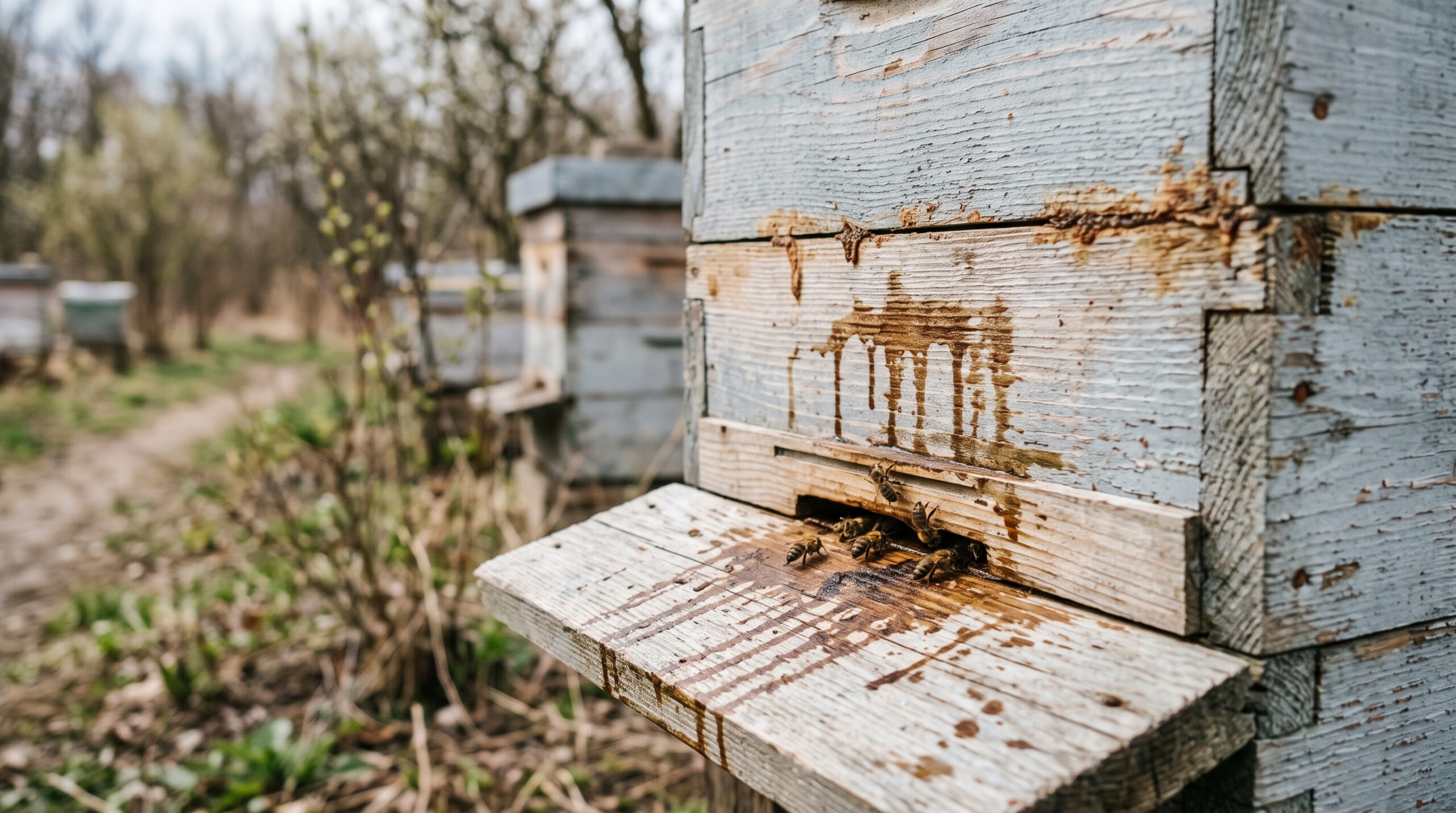
Brown streaks across the front of your hive, smeared on the landing board, or staining the wood below the entrance — these are the classic signs of bee dysentery, and they range from a minor winter inconvenience to a symptom of something more serious. New beekeepers often find these marks alarming and immediately suspect disease. Experienced beekeepers know that context matters enormously: late winter dysentery after weeks of cold confinement is expected and usually not cause for concern. Spring or summer dysentery, or dysentery in colonies that have had flight opportunities, is a different matter entirely.
Let’s break down what bee dysentery actually is, what causes it, and when you should actually worry.
What Bee Dysentery Is and Isn’t
Honey bees are remarkable in their ability to delay defecation during cold confinement — they retain feces in their rectal ampulla for months if necessary, a critical adaptation for surviving winter without fouling the hive. When that capacity is exceeded — either because confinement lasted too long, the bees consumed too much indigestible material, or something disrupted gut function — the bees defecate inside the hive or at the entrance rather than on cleansing flights.
The feces are brown and liquid, with a distinct unpleasant smell. Heavy dysentery inside the hive creates dark streaks across frames, comb faces, and hive walls. This is problematic not because of the smell but because wet conditions promote fungal and bacterial growth, and because bees weakened by gut distension are less able to perform their normal hive functions.
Bee dysentery is a symptom, not a diagnosis. The underlying causes vary considerably:
- Extended winter confinement with high-moisture stores: The most common cause. Honey with high water content (improperly cured, or crystallized honey high in glucose) requires more digestive processing and produces more waste. Dark honey from honeydew (aphid excretions rather than flower nectar) contains higher levels of indigestible carbohydrates.
- Fermented or poor-quality winter stores: Improperly stored honey that has begun to ferment causes gut upset. Bees fed syrup too late in fall that wasn’t adequately converted also produces poor-quality winter stores.
- Nosema ceranae or Nosema apis: Nosema is a gut pathogen that directly causes dysentery in infected bees. N. apis in particular has a strong historical association with spring dysentery, including the characteristic fecal streaking on the hive front. A colony with unusual early-season dysentery warrants a microscopy check for nosema spores.
- Insufficient cleansing flights: Extended cold spells with no breaks (no days reaching ~55°F or above) leave bees unable to fly out and relieve themselves. After 4–6 weeks of confinement, even healthy colonies may develop dysentery.
When to Worry vs. When Not To
The clearest guidance I can give:
Not a major concern:
- Brown streaks at the hive entrance appearing in late winter/early spring after a prolonged cold period, followed by the colony recovering once bees can fly.
- A colony that takes a good cleansing flight and shows no internal dysentery signs within a week of first warm days.
- Light streaking in one or two hives while others are clean, especially if those hives had less ideal winter stores.
Warrants investigation:
- Dysentery appearing in spring or summer when bees have regular flight opportunity. Healthy bees don’t defecate at the entrance when they can fly out. This points toward nosema or another digestive disorder.
- Heavy dysentery inside the hive — across frames, on the inner cover, throughout the colony. This level of internal fouling indicates serious gut distress.
- Colony is also showing rapid population decline alongside dysentery.
- Multiple hives in the apiary showing dysentery simultaneously — points toward a shared cause (poor-quality winter feed, nosema outbreak, or contaminated water source).
Distinguishing Dysentery from Other Fecal Marks
Not every brown mark on a hive is bee dysentery. Consider:
- Small hive beetle frass: Smaller amounts, mixed with debris and silk. Usually inside the hive near comb, not at the entrance.
- Water staining or weathering: Brown streaks can result from rain, wood tannins, and weathering. If the marks aren’t watery-looking or smelly, they may not be fecal.
- Normal defecation spots: Bees sometimes defecate near the entrance on warm days in winter. A few small spots are normal; sheets of brown streaking are not.
What To Do
- Winter dysentery, no flight opportunity: Monitor but don’t open the hive in cold weather. Hope for a warm spell. If a 55°F+ day arrives, confirm bees are taking cleansing flights. Most colonies recover quickly once they can fly.
- Check winter food stores quality: If you fed late-season syrup, ensure it was a 2:1 ratio and bees had adequate time to convert it. In future seasons, finish all syrup feeding before mid-September so bees have time to ripen stores properly.
- Run a nosema check if dysentery is unusual: Collect 30+ bees from a brood frame, grind in water, and examine under a microscope at 400× for spores. Your state extension service can also run this analysis on a submitted sample.
- Improve ventilation in future winters: High humidity inside the hive contributes to dysentery. Ensure the hive has adequate top ventilation (a small notch in the inner cover or a top entrance) to allow moisture to escape.
- Consider store quality for next year: Feed sugar syrup rather than honey of uncertain quality for winter stores if you’re supplementing. Pure cane sugar syrup is low in indigestibles compared to dark or unprocessed honey.
Bee dysentery as a standalone winter event, resolved by spring cleansing flights and warmer weather, is not a crisis. What makes it worth attention is the pattern — when it shows up at the wrong time of year, in multiple hives, or alongside population loss. Pay attention to context, test for nosema if you’re suspicious, and focus on improving winter store quality and hive ventilation to prevent recurrence.