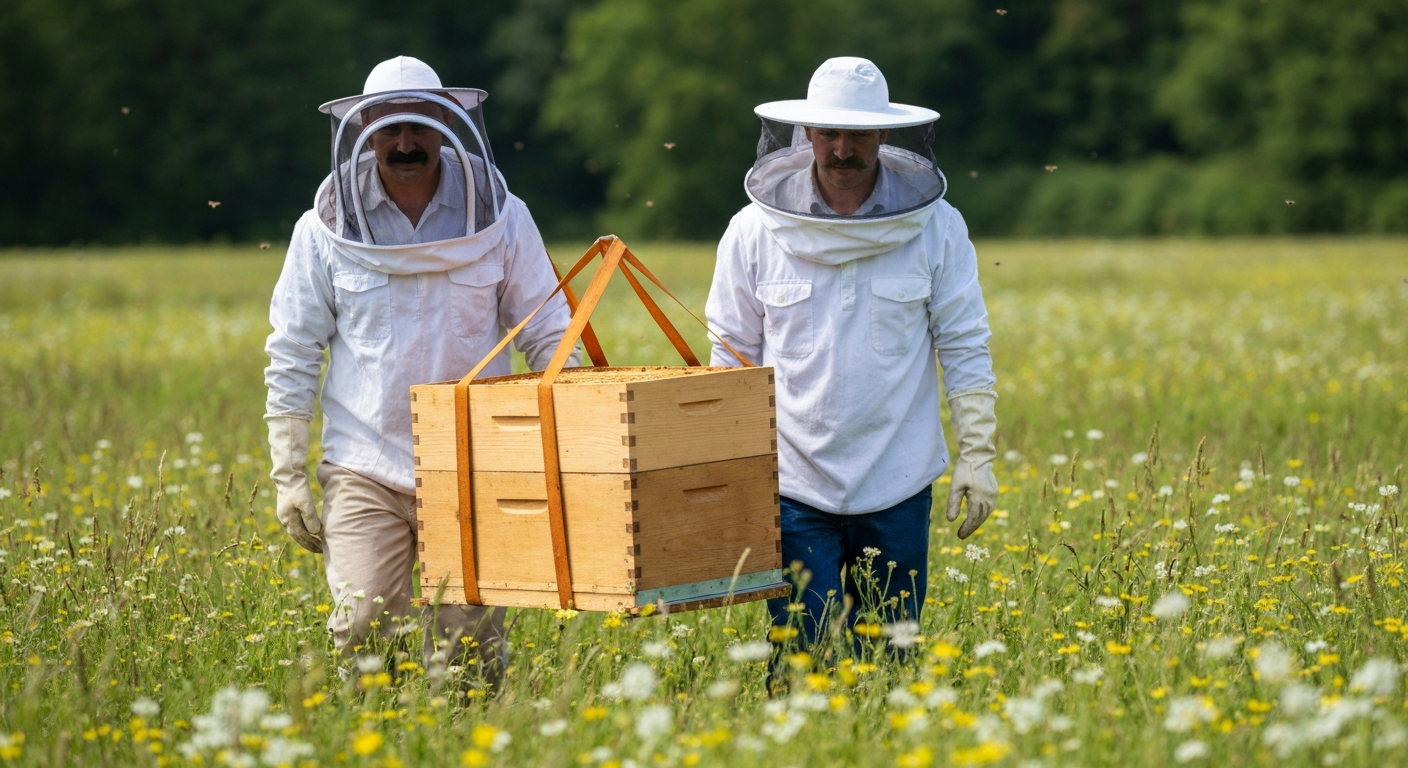
Bees are extremely loyal to their location. When foragers leave a hive to collect nectar or pollen, they memorize the sun angle, surrounding landmarks, and flight path back to within a foot or two of the entrance. Move a hive just six feet to the left, and returning foragers will cluster in confusion at the old location until they figure out something has changed. Move a hive three miles away, and they start fresh without a problem. Understanding this quirk of bee navigation is what makes hive moving either a smooth operation or a disaster.
I’ve moved hives for a dozen reasons over the years: neighbor complaints, a new property, better forage access, getting away from a pesticide-heavy area, moving colonies to pollination sites. Each situation is a little different, but the core principles stay the same. Get the timing right, secure the equipment well, and give the bees what they need to reorient successfully.
The “Three Feet or Three Miles” Rule
This is the most important concept in hive relocation. Bees memorize their flight paths within a specific radius. If you move a hive anywhere in the range of a few inches to about three miles, a significant portion of the forager population will return to the original location and find nothing. In your yard, those lost bees may find their way to a neighboring hive. Three miles away, the bees are in unfamiliar enough territory that they reorient to the new location without problem.
For short moves within the same yard:
- Move the hive no more than two to three feet per day
- It will take several weeks to inch it across the yard, but bees will adjust
- Or move it three+ miles away for at least three weeks before returning it to its new location in the yard
Planning the Move: Timing and Preparation
The best time to move a hive is evening or early morning, after flying bees have returned for the night. This minimizes the number of bees outside the hive and ensures almost all foragers make the move with the colony. Moving at midday means you’ll leave thousands of bees behind at the old location — they’ll cluster there confused and eventually drift to other hives or die.
Before moving:
- Close the entrance completely the night before with a foam plug, entrance reducer, or folded mesh. Do this after dark when all bees are home.
- Check that frames are not cross-combed or stuck in a way that will allow them to shift during transport.
- Strap or ratchet-tie the boxes together so they don’t separate in transit.
- Make sure the screened bottom board (if used) has its solid insert in place, or the hive is otherwise stable.
Securing the Hive for Transport
A moving hive that comes apart in your truck is a nightmare. Use at least two ratchet straps — one horizontal to bind the boxes together, one to secure the whole stack to a truck anchor point or dolly. Foam in the entrance keeps bees contained without overheating, but you need ventilation somewhere: keep any screened bottom open, or use a screen-covered entrance block that contains bees while allowing air flow.
For long-distance moves (hours in a vehicle), consider:
- Placing hives in the truck bed early morning when temperatures are cool
- Covering hives loosely with burlap or shade cloth if direct sun hits the truck bed
- Checking that bees aren’t overheating during loading — a hot hive with too many bees pressing the screens can collapse the cluster
After the Move: Helping Bees Reorient
When you place the hive at the new location, open the entrance and stand back. Bees will immediately begin orientation flights — hovering in front of the hive and flying in widening arcs, memorizing the new location. This is completely normal and looks alarming to people who haven’t seen it before. Dozens of bees circling in front of the hive for 20–30 minutes means the bees are doing exactly what they need to do.
A few tricks to speed reorientation:
- Place leafy branches in front of the entrance when you first open it — the visual disruption encourages bees to look up and re-memorize their surroundings rather than flying straight out on autopilot
- This is especially useful for short local moves where old location memory might compete with new
The Neighbor Problem
If you’re moving hives to a new yard near residential neighbors, consider their flight path. Bees flying out in a straight line across a neighbor’s yard is the most common complaint — and often the most easily solved one. Orient hive entrances toward a fence or dense hedge so bees fly up and over the barrier, rather than at head height through a yard. A six-foot fence or hedge forces bees above the neighbor’s activity zone within twenty feet. I’ve solved more neighbor conflicts with a simple fence reorientation than with any amount of conversation.
- Orient entrances away from foot traffic zones
- Use hedges, fences, or structures to direct flight paths upward
- Move hives as far from property lines as feasible
- A jar of honey to the neighbors never hurts
Moving a hive is one of those jobs that feels nerve-wracking the first time and becomes routine by the third. The key is preparation — close the entrance, secure the boxes, move at night, and give the bees time to reorient. Do those things right and you’ll have a fully functional colony at the new location within a day or two with minimal losses.