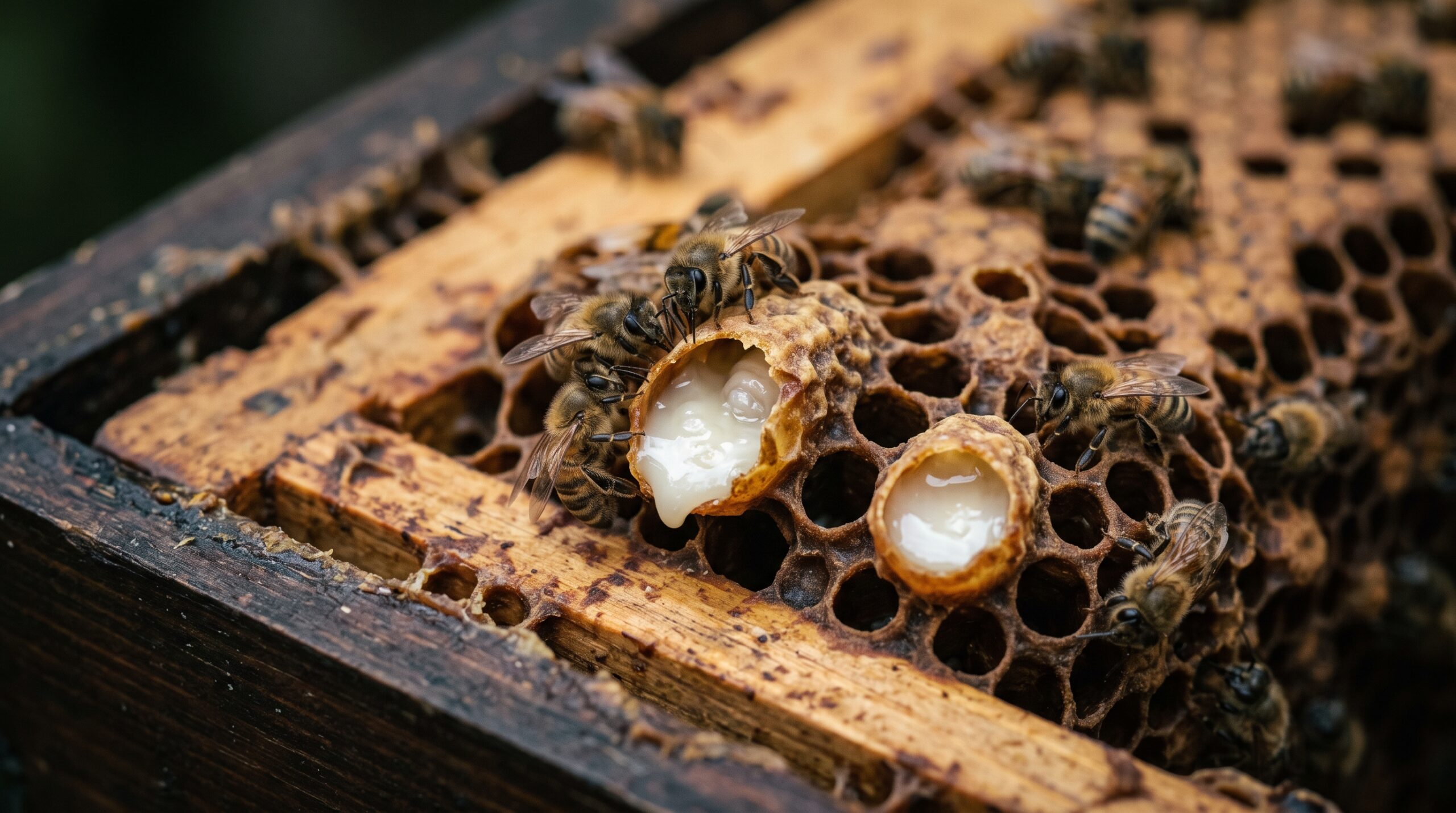
Royal jelly gets more attention in health food stores than it does in most backyard apiaries, and there’s a reason for that gap. The gap isn’t about quality — bees produce the same royal jelly regardless of the size of the operation. The gap is about the labor involved in collecting it. Commercial royal jelly production is tedious, time-intensive, and requires a skill set that goes beyond basic beekeeping. Before you invest in specialized equipment and spend a season learning the technique, you deserve an honest assessment of whether it makes sense for a small operation.
Here’s the real picture, based on my own attempt to produce royal jelly from a four-hive test setup over one summer.
What Royal Jelly Is and Why It’s Valuable
Royal jelly is a protein-rich secretion produced by the hypopharyngeal glands of young nurse bees. All larvae receive it for the first 1–3 days of life. Larvae designated to become queens continue receiving it throughout their development — the differentiation between a worker bee and a queen bee comes almost entirely from this dietary difference. A genetically identical larva becomes a 6-week worker or a 5-year queen based on whether royal jelly feeding is stopped or continued.
The main bioactive compound in royal jelly is 10-hydroxy-2-decenoic acid (10-HDA), a fatty acid with demonstrated antimicrobial and biological activity. Additional proteins (MRJPs — major royal jelly proteins) and acetylcholine are also present. Research on human health effects is limited and results are mixed, but the market for royal jelly is substantial — particularly in Asian markets where it commands high prices.
Fresh royal jelly sells for $15–50 per ounce at retail, and significantly more in processed or pharmaceutical forms. That sounds lucrative until you understand the production volumes a small apiary can realistically achieve.
How Royal Jelly Is Collected
Royal jelly can only be collected from queen cells. The maximum jelly volume in a queen cell occurs around 3 days after an egg hatches, when the larva is bathed in jelly but before it starts being consumed by larval growth. The process:
- Graft larvae from worker cells into artificial queen cups (plastic or wax cups that mimic the base of a queen cell).
- Introduce grafted cups into a queenless or queen-right cell-building colony that has abundant young nurse bees. These bees will accept the grafted larvae and begin building queen cells around them, filling them with royal jelly.
- Harvest after 68–72 hours. Pull the frames with developing queen cells, remove the larvae with a fine tool (they must be removed without damaging them or rupturing the jelly), and extract the jelly with a small vacuum device or suction pipette.
- Refrigerate or freeze immediately. Fresh royal jelly degrades quickly at room temperature — it must be kept cold from the moment of harvest until consumption or processing.
A productive queen cell contains roughly 200–300mg of royal jelly. That’s about a quarter teaspoon per cell. To produce 1 ounce (28g) of royal jelly, you need to harvest approximately 100 queen cells.
The Production Math for Small Apiaries
A well-managed cell-builder colony with a strong nurse bee population can accept 30–60 grafts per round, and you can run a new round every 3–4 days during peak season. With 40 accepted grafts per round at 250mg each, that’s roughly 10g per round, or about 0.35 oz.
So a three-day cycle produces less than half an ounce of jelly from one dedicated cell-building hive. In a month of active production with ten rounds, you might accumulate 3–4 ounces. At $25/oz, that’s perhaps $75–100 in raw jelly.
But consider the inputs: grafting 40 larvae per round requires skill and time (30–45 minutes per grafting session for a practiced beekeeper; much longer for a beginner). You need grafting tools, plastic queen cups, a cell-building colony managed specifically for this purpose, and cold storage and processing equipment. The grafting success rate for beginners is often below 50%.
Is It Worth It for Small Beekeepers?
Honestly, for most people with fewer than twenty hives, royal jelly collection is not worth the effort unless you’re deeply interested in the technique for its own sake. The time-to-return ratio is poor compared to honey and wax, and the skill ceiling for grafting is significant. Professional royal jelly producers run hundreds of hives specifically for this purpose and have automated grafting and harvesting tools to scale efficiently.
Where it might make sense for a small beekeeper:
- You’re already raising queens for your own operation and can collect jelly as a byproduct of your queen-rearing workflow.
- You have a local market — a health food store, Asian grocery, or direct customer base — willing to pay premium prices for fresh, local royal jelly.
- You enjoy the technical challenge of grafting and queen rearing and want to monetize a skill you’re developing anyway.
If You Want to Try It Anyway
The resources I’d point you to: Michael Palmer’s talks on queen rearing (available online) cover grafting technique in depth. “The Hive and the Honey Bee” (Dadant) has a full chapter on royal jelly production. For equipment, a Jenter or Nicot kit eliminates grafting entirely by letting the queen lay directly into artificial cells — harder to perfect but removes the most skill-intensive step.
Start with one cell-builder colony, one round of 20 grafts, and see what you learn before scaling. If your graft acceptance rate is good and you enjoy the process, it can become a worthwhile part of your apiary’s product line. If it’s mostly frustrating, that’s useful information too.
Royal jelly is a remarkable product from an astonishing process. Whether collecting it is right for your operation depends entirely on where your time and skills are best invested.