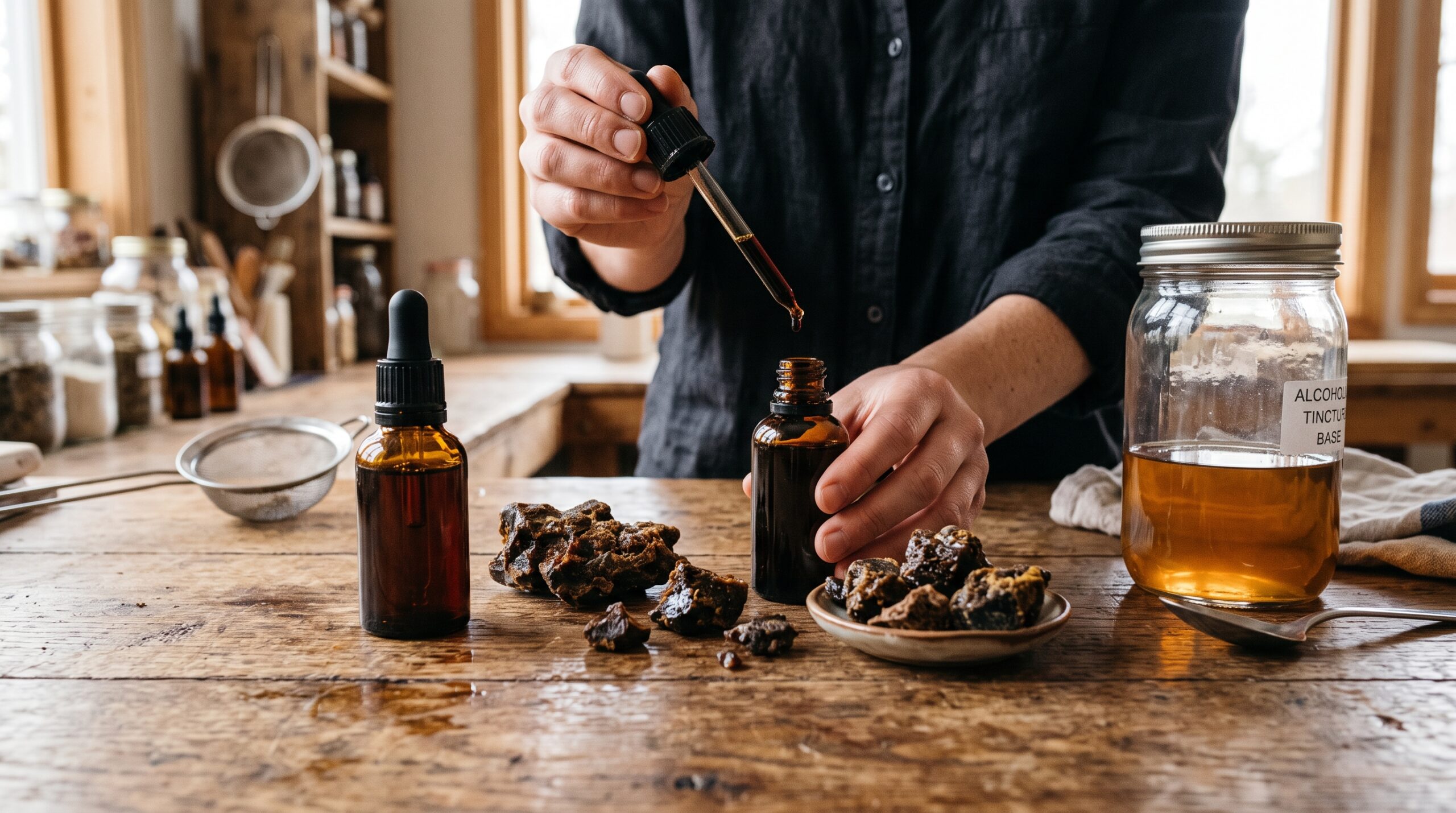
Propolis is one of the less glamorous things bees produce, but it’s been used medicinally for thousands of years — by ancient Egyptians, Greeks, and folk healers across cultures who likely didn’t know why it worked, only that it did. Modern research has caught up enough to confirm what beekeepers have known anecdotally: raw propolis has demonstrated antimicrobial, antifungal, and anti-inflammatory properties, though the strength of these effects varies considerably by its botanical source.
The easiest way to extract those properties into a usable form is an alcohol tincture. It takes about five minutes of active work, a few weeks of patience, and ingredients that are easy to get. Here’s the method I use in my apiary, which has changed very little over a dozen years of making it.
What Is Propolis, Exactly?
Propolis is a resinous compound bees collect from tree buds, sap flows, and other botanical sources, then mix with wax, enzymes, and other compounds to produce a sticky, sealant-like material. Bees use it to seal cracks in the hive, smooth rough surfaces, coat the inside of cells before the queen lays in them, and mummify intruders too large to remove (a dead mouse encased in propolis stays preserved rather than rotting and introducing pathogens to the hive — a remarkably practical solution).
The chemical composition of propolis varies by geography and what trees are available. Propolis from temperate North America and Europe is typically rich in flavonoids (pinocembrin, quercetin, caffeic acid phenethyl ester, or CAPE), which are the compounds most associated with its antimicrobial activity. Tropical propolis from Brazil, Cuba, and other regions has a very different chemical profile — sometimes containing different bioactive compounds. The short version: propolis quality and composition vary, and what your bees make depends heavily on your local flora.
Collecting Propolis from Your Hives
You’ll have propolis available any time you work your hives — it’s the brown sticky stuff coating everything, including your gloves and hive tool. For intentional collection:
Propolis traps: These are plastic or mesh sheets with small slits placed on top of the frames instead of the inner cover. Bees fill the slits with propolis to seal them (they try to seal every gap). After a few weeks, pull the trap out, put it in a plastic bag, and freeze it overnight. Frozen propolis becomes brittle; flex the frozen trap over a clean bucket and the propolis fragments drop out.
Scraping collection: Scrape propolis from frame edges, hive bodies, and your hive tool throughout the season into a jar. This produces less clean propolis with more wax mixed in, which affects the final tincture appearance but not significantly its efficacy.
In my apiary I use both methods. Trap propolis goes into tinctures. Scraped propolis goes into skin salve where the mixed-wax content isn’t an issue.
Making the Tincture: Ingredients and Process
What you need:
- Raw propolis — approximately 10–30g per 100ml of alcohol (10–30% concentration by weight)
- High-proof alcohol — 70–90% ethanol (isopropyl is not food-safe; use ethyl alcohol). Everclear at 95% (190 proof) is excellent. Vodka at 40% works but extracts less efficiently and produces a weaker tincture.
- A glass jar with a tight lid (dark glass preferred, like an amber bottle)
- A fine mesh strainer or cheesecloth
- Dark amber dropper bottles for the finished product
The process:
- If using scraped propolis with wax mixed in, freeze it and remove as much visible wax as you can. The alcohol will dissolve the propolis but not the wax; wax just settles and is filtered out later.
- Roughly break up or chop the propolis into smaller pieces to increase surface area. Frozen propolis crumbles easily.
- Combine propolis and alcohol in the jar. I typically use 20g propolis per 100ml of alcohol for a medium-strength tincture.
- Seal tightly and store in a cool, dark location. Shake daily if you remember, or every few days if you don’t.
- Wait 2–4 weeks. Longer is generally better — four weeks produces a more fully extracted tincture than two. The alcohol will turn a deep amber-brown color as compounds dissolve into it.
- Filter through several layers of cheesecloth or a coffee filter into your amber dropper bottles. Press the propolis mass firmly to extract remaining liquid.
- Label with date and concentration. Store away from heat and light.
How People Use Propolis Tincture
The most common use is as an oral supplement, typically a few drops in water or juice. Many people use it at the first sign of a sore throat, cold symptoms, or minor mouth irritation. Applied topically, diluted tincture can help with minor cuts and skin irritation.
A few practical notes: propolis tincture stains everything it touches a reddish-brown color. Keep it away from fabric and countertops you care about. It has a strong, distinctive flavor — slightly bitter, resinous, and complex. The high-alcohol concentration makes it unsuitable for children and anyone avoiding alcohol.
I’m not going to make medical claims about propolis — the research is promising but the studies are mostly small and often industry-funded. What I can say is I’ve been taking propolis tincture during cold season for fifteen years, and I find it useful. Whether that’s the propolis or something else entirely, I genuinely don’t know. But it costs me almost nothing to make from a byproduct I’d otherwise scrape off the hive tool and discard.
Common Mistakes to Avoid
- Using isopropyl alcohol: For a topical-only product this may be acceptable, but if there’s any chance of ingestion, use food-grade ethanol only.
- Not waiting long enough: Two weeks is a minimum; four is better. Rushing produces a weaker product.
- Skipping dark storage: Propolis compounds degrade with UV light exposure. Dark glass bottles and a dark storage location extend shelf life significantly.
- Expecting a clear product: Propolis tincture is inherently turbid and dark. That’s fine. Some cloudiness at the bottom after filtering is normal — wax residue.
Making propolis tincture is one of those simple value-adds from your apiary that takes almost no extra time once you’ve done it once. The hardest part is waiting the four weeks. After that, you’ve got a useful product from material you’d otherwise clean off your equipment — which feels like exactly the right approach to beekeeping.